Showing posts with label the Whitney Museum. Show all posts

Friday, August 13, 2010

Rothko's Biography On My Mind in New York

Still in my photo collection and not yet posted - lots of shots from my trip to New York last month. Less than a month has passed since my visit, but those photos are tugging at my sleeve, just dying to get online. (Now that's a ridiculous image!) So I'm trying to sort all my New York photos into some semblance of meaning, and one of the categories I came up with was work by Mark Rothko.


My photo of Mark Rothko's "Four Darks in Red", 102 x 116 inches, 1958, at The Whitney Museum


The Whitney's photo of the same painting. This painting is included in The Whitney's current exhibition "Collecting Biennials", up until November 16th. As you exit the elevator to the exhibition floor, this painting is facing you. 


In April 2009 I did a 6-part post on Rothko based on the biography by James Breslin. Breslin's book was truly a monumental achievement, and I don't think anyone can ever write such a well-documented history of Rothko's life. As a result of reading that wonderful work so closely and posting so densely about Rothko, I feel a real affinity to his work. When I see a Rothko painting, I'm thinking about the history of its making, who bought it, was it involved in some struggle, etc. So apparently with all this on my mind, I didn't do a very good job of photographing the paintings. I felt that I was so familiar with them, that I was just shooting for reference or something. So I'm giving you my photo version and the official version. The strange thing is that neither one really captures the paintings. I think they are somewhere between the two.

As I was reflecting on all the work I had seen in New York and trying to recall the standouts, one of the most impressive to me was Rothko's Slow Swirl at the Edge of the Sea.


My version of "Slow Swirl at the Edge of the Sea," 1944, oil on canvas, approx. 6' H x 7' W


MoMA's official "Slow Swirl"


Here's what I said about it in my April 2009 post:


Rothko showed 15 of his myth-based, automatic drawing-inspired oil paintings [at Peggy Guggenheim's Art of the Century Gallery in New York]. One of these works was "Slow Swirl at the Edge of the Sea." Breslin calls it his "largest, most ambitious, and in Rothko's view the 'most important' work he had so far attempted." Before reading Breslin's book, this is the only painting of Rothko's that I had ever seen from the body of work that he painted prior to his mature style. It usually looks a lot more dingy and brown, but is the one painting that all the art histories show. This painting was purchased by Peggy Guggenheim as the token piece that she bought from each one-man show in her gallery, and it's now owned by the Museum of Modern Art. Breslin says that Rothko sold only three paintings from the show, one being Slow Swirl, and that the total he received for all three was $265! Isn't that incredible?

(Slow Swirl did not go from Peggy to MoMA. She loaned it to the San Francisco MoMA and then gave it to them in 1946. In 1962 Rothko exchanged another painting for Slow Swirl, which he then gave to his second wife, Mell, and hung it in their living room. Mell had watched him paint it and felt that it was dedicated to her. This painting meant a lot to both of them, and it was donated to MoMA, NY after Mell's death.)


Although I knew what the dimensions of this painting were, I had visualized it as being maybe 36" x 40". In person it's much more impressive and the color is not as dingy as the art history books show it. It seems like a very large painting for an average living room and certainly too big to go over a couch.

Currently showing at MoMA on the same wall as Slow Swirl are several early Rothkos that were made in the mid '40s before he found his style. At this time he was in the Surrealism/psychic automatism phase. These three pieces were painted in the early to mid 1940s, around the time of Slow Swirl and are watercolor and ink on paper.


In the first and third of these he seems to be struggling with those bands of color that eventually took over his work. These pieces are not much to look at but a good illustration of how artists develop and grow.

Of course it's the oil paintings that Rothko is known for and MoMA had several on display. The most famous of them (to me at least) is No. 10.


My version of No. 10


The National Gallery's version of No. 10. This work was painted in 1950 and is 7'6" H x 57" W.


MoMA's version of No. 10.


Here's what I wrote about it in my blog post:

A review of Rothko's prices shows that they were continuing to increase as his reputation grew. In the 1951 show at Parsons, his prices ranged between $500 and $3,000, with most in the middle of that range. But in 1951 Rothko sold only one painting, his Number 10, 1950. Alfred Barr, Director of MoMA, wanted to acquire this painting but knew his board would not approve the purchase, so he got Philip Johnson to buy it and donate it to the museum. (Feelings against Rothko were so strong that one board member resigned in protest even of the donation!) The price at Betty Parsons Gallery for the painting was $1500, but Johnson was given a 25 percent discount, reducing the price to $1200. Rothko's share was only $830, but this changed within a few years.


The sad fact about this painting is that the color has deteriorated to the point that it's barely there. The National Gallery image is not true to life at all. Rothko had some very inventive formulas and methods of painting.

Here's what I wrote based on Breslin:
Structure was not important to Rothko, but the paint was. He imagined himself "breathing paint on the canvas" in light, transparent washes that looked as though a brush had never touched them. His painting technique combined the traditional with the experimental. He sized the unprimed canvas with rabbit skin glue colored with powdered pigment. He then covered the glue size with a layer of oil paint in about the same color, extending this layer over the top and sides of the canvas, which was not to be framed. The sides of the canvas showed tacks holding the canvas to the support. Susequent fields of color were glazes mixed with whole eggs and then thinned with turpentine. Glazes were thinned to the point that "pigment particles were almost dissociated from the paint film, barely clinging to the surface," a conservator points out. Because it was so thin, "light penetrated the attenuated paint film, striking the individual pigment particles and bouncing back to suffuse the surface and engulf the viewer in an aura of color."

I was surprised to read about eggs with oil painting, but looked it up on the trusty internet and found that this technique belonged to the "Old Masters." "In the fifteenth century, with the development of oil painting, egg-oil emulsions came into use. Soon after, egg tempera took second place to oil paints and became just a convenient medium for underpainting before the application of oil paints. Many of the old masters used a green earth tempera color underpainting in their oil paintings to create more realistic flesh tones." (from Art Hardware: The Definitive Guide to Artists’ Materials) This article also says that using eggs allows a wash to be applied over a wash of a different color without the two mixing together and becoming muddy and permitting both colors to be seen together so that a blue wash over a red looks purple. It also makes for greater transparency.


Here is my pal Binnie looking at the side of a Rothko at all the construction materials behind it that conservators have evidentally applied.(This may have been the side of No. 10, but I'm not sure.) I remembered reading about Rothko using the cheapest materials possible to stretch his canvases. Here's what I wrote (aren't you getting sick of me quoting myself?):

Breslin says that Rothko was not much of a carpenter and used the cheapest materials he could find such as packing cases held together with staples. "Gee what a relief to be able to look at the back of a Rothko and not think of a chicken coop," said Franz Kline when he heard that Rothko was hiring a studio assistant. Sidney Janis said he was "guilt ridden" to sell Rothko's badly put together paintings to a collector in a Fifth Avenue duplex who would hang it on the wall "in the company of great antiques."


My version of No. 3/No. 13 (Rothko changed his numbering system)


MoMA's version of No. 3/13, 1949, 7'1:H x 65" W


My version of No. 5/No. 22


MoMA's version of No. 5/22, 1949, 9'9" H x 8'11" W


My version of No. 16


MoMA's version of No. 16, 1958, 8'10" H x 9'9" W (notice how the bottom color band is showing green coming through)


Clifford Still's painting hanging next to Rothko's No. 16

I'm sorry that I did not note the title of this work by Clifford Still and MoMA does not show images online of any of his works so I couldn't find it that way. I got a kick out of seeing these two paintings hanging side by side because Rothko and Still were great friends in the 1940s and networked with each other early on. Still introduced Rothko to the West Coast and arranged for him to teach at the California School of Fine Arts; Rothko introduced Still to New York and even stored Still's paintings in his studio. There are some art historians who even claim that Still was responsible for Rothko's breakthrough into his signature style. Later in the early '50s they had a falling out and stopped speaking.

Here is Still's description of his friend Rothko before the breakup:
"We were complete opposites. He was a big man. He would sit like a Buddha, chain-smoking. We came from different sides of the world. He was thoroughly immersed in Jewish culture. But we had grown up only a few hundred miles apart. We had read many of the same things. And we could walk through the park together and talk about anything." (quoted in Breslin)


A late photo of Rothko

If you want to read my posts about Rothko, you can start here.

Saturday, August 7, 2010

Lee Bontecou - Personal Inspiration - Part 1

Lee Bontecou in her studio, photographed in 2003 by Will Brown,
from Lee Bontecou: A Retrospective, details below.

Sculptor Lee Bontecou is someone whose work I have long admired. During my recent trip to New York, I visited the smallish exhibit of her work at the Museum of Modern Art, entitled "All Freedom In Every Sense." That title is a quote from Bontecou in a 2002 letter in which she said that she wanted her work to be about "as much of life as possible - no barriers - no boundaries - all freedom in every sense." (quoted by Elizabeth A.T.Smith in her essay about Bontecou in Lee Bontecou: A Retrospective, a beautiful book published in conjunction with a 2004 retrospective of Bontecou's work that was curated by Elizabeth A. T. Smith and Ann Philbin, co-organized by The Museum of Contemorary Art, Chicago and the Hammer Museum, Los Angeles.)


Untitled, 1961, welded steel, canvas, wire, and rope, 72 5/8 × 66 × 25 7/16 in., collection
of the Whitney Museum. I saw this in NY last month too, but couldn't photograph it. This photo is
from the Whitney's website and is probably better than one I could have taken.


The course of Bontecou's art career is as original as her work. She hit the high point in the late 1950s and '60s, was "rediscovered" in the 1990s and came into her own in the 2000s. In part 2 of my post, I will go into more details of her history. Today I just want to show you some photos that I took at MoMA last month.

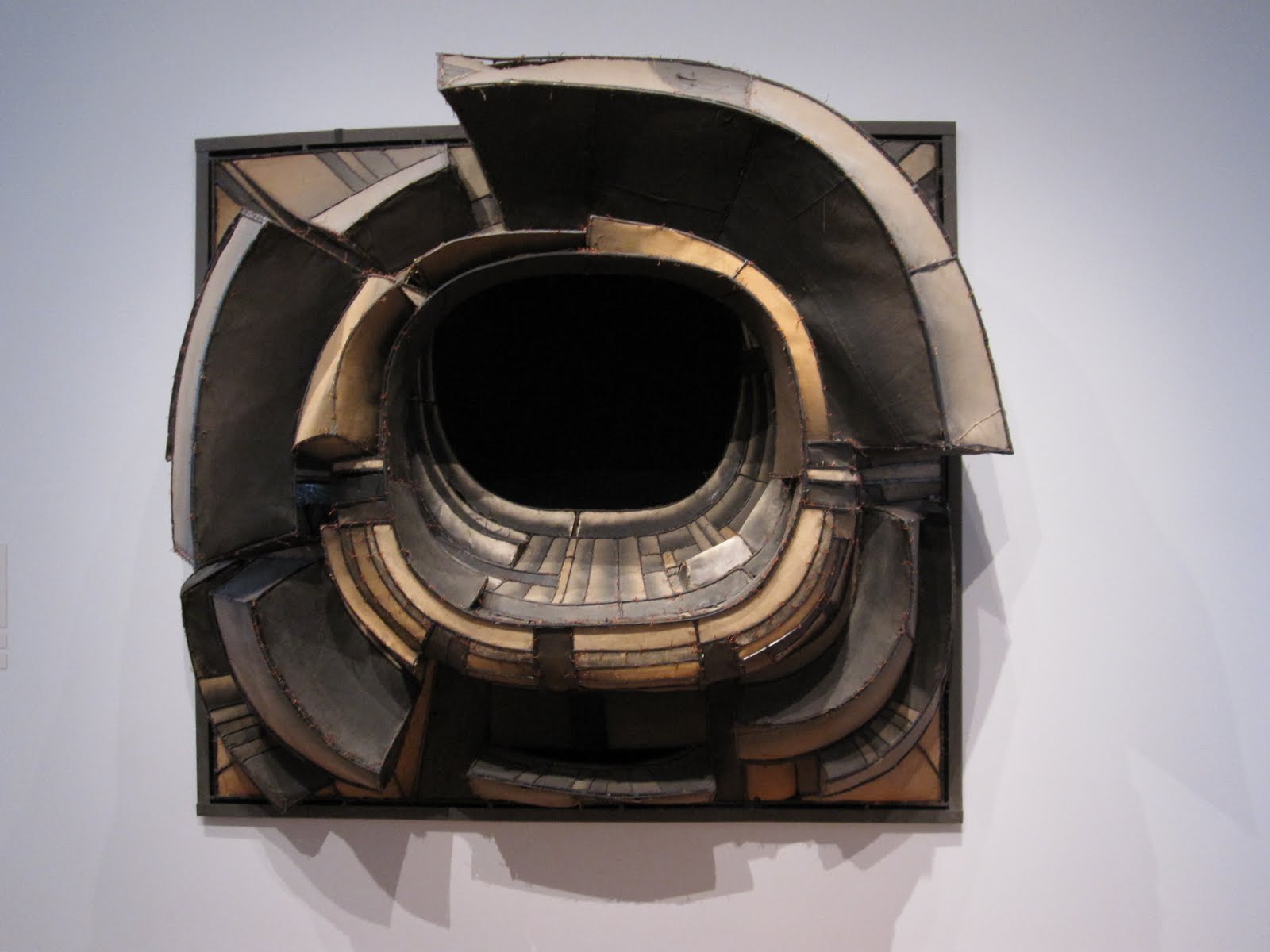
The MoMA show had only two of her wall-mounted steel, canvas and wire sculptures and they were two that MoMA owns. I'm not sure whether MoMA owns the other work in the show - mostly drawings and one work that hangs from above. Getting to see her wall sculptures up close and personal was a real treat for me because I could really look at the detail with my myopic perspective.


Untitled, 1961, welded steel, canvas and wire, 80 1/4 x 89 x 34 3/4 inches.


Same piece viewed from left side.


Same piece viewed from right side.

Bontecou learned to weld one summer at the Haystack School in Maine after studying painting at the Art Students League in New York and sculpture with William Zorach. During a Fullbright year in Rome, where she worked on sculptures of abstracted animal figures, she discovered that the blowtorch she used for welding could also be used as a drawing tool by turning off the oxygen so that it emitted soot. When she returned to the U.S. and began working in a studio on NYC's Lower East Side, she utilized the torch both for welding and drawing, creating welded steel armatures to which she attached pieces of worn canvas collected from a neighborhood laundry. She added varying shades of darkness to the canvas using soot from the torch.


Soot drawing at MoMA. (Note for some reason this image won't rotate correctly. The two white dots that you see at top left of the image should actually be at the bottom. That means that this view shows the drawing on its side.


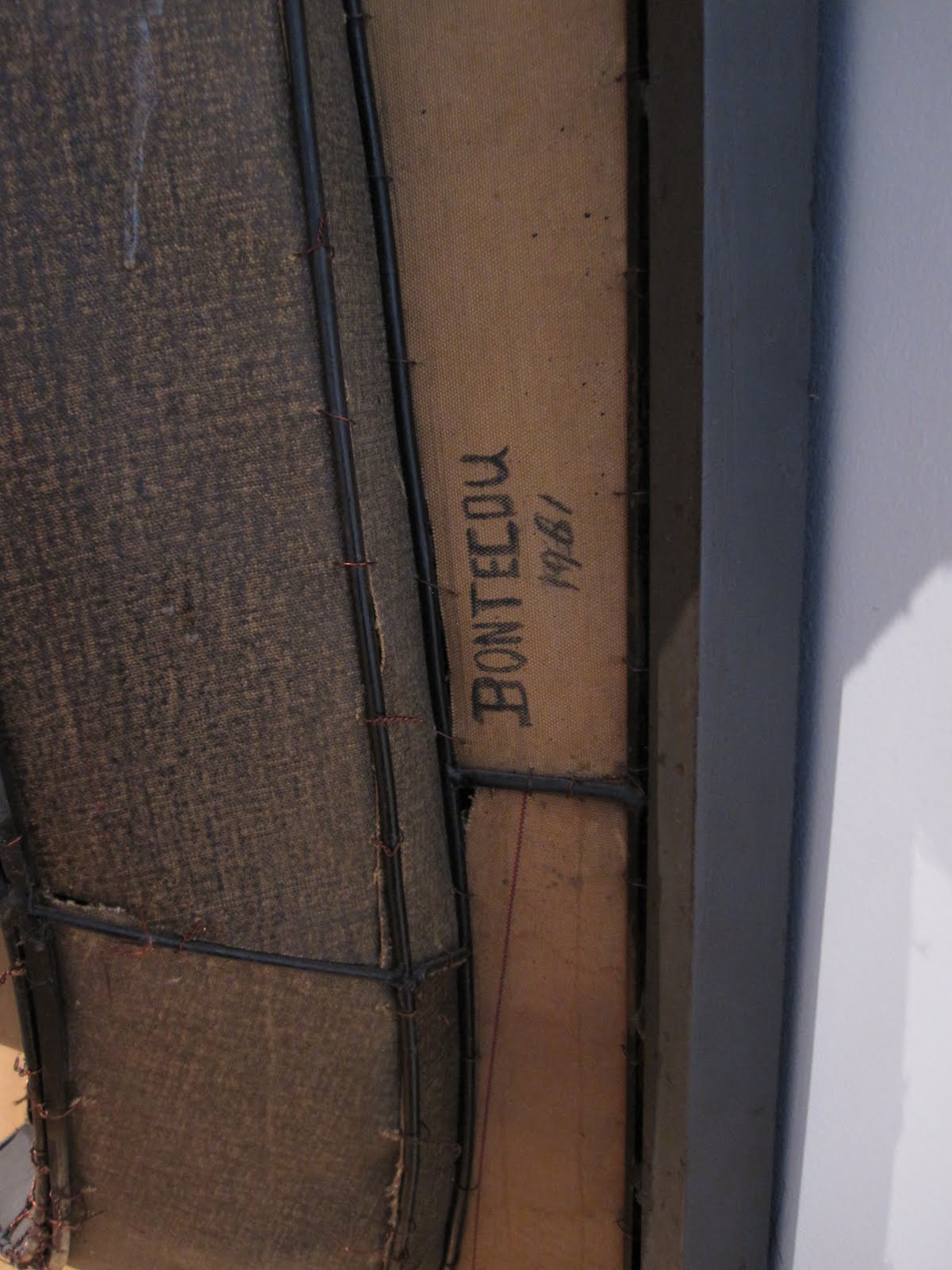
1959, welded steel, canvas and wire, 58 1/2 x 58 1/8 x 17 3/8 inches.


View of same piece from right side.


Bontecou's signature on same piece.


Bontecou was quite successful with this work, showing at Leo Castelli's gallery and being accepted as one of very few women artists at the time. Her work continued to develop in new directions from these wall sculptures, and I'll show you more of this in my continuing post about her.

One of the directions in which her work developed was in airy, galaxy-like pieces that hung from the ceiling and were composed of hundreds of small pieces of wire, wire mesh, porcelain and other materials. MoMA had a large work of this type on display and I found it fascinating. It moved slowly in the air currents and cast intricate shadows on the cleverly-installed platform beneath it that also served to keep viewers at a distance.


Tune in again for part 2 in which I include more photos of Bontecou's work.

Monday, July 26, 2010

Arting in New York


Both times this year that I've been to New York there have been weather extremes. Last February Binnie and I trudged through 17 inches of snow to see El Anatsui and Leonardo Drew in Chelsea. This past weekend, we drove in through torrential rainstorms on Friday and trained in on Saturday in temps that were 90-plus degrees by nine in the morning in the Connecticut exurbs. But what's a little weather when there's so much to see!

So I went a little crazy with the photographs of course and now the thought of resizing and adjusting them is making me feel tired already. But I never expected to use them all.


Conveying the vast richness of what we saw seems daunting and better approached by dividing to conquer it all. I propose doing a series of posts with images and details of those I thought were outstanding. Some of them have already been covered extensively and unbeatably by Joanne Mattera, so I'm going to skip those but maybe mention some of my personal favorites in those shows.


An assemblage of NY memorabilia including a photo of Binnie and me waiting in line outside the Whitney on Friday evening, snapped by a Keds' promotion staffer.

So here is a list of prospective posts with an image from each of them to pique your interest. I'm not sure about the order in which they'll actually appear, but these are things I would like to cover.

Tutankhamun's Funeral at the Metropolitan Museum 


One of the necklaces/collars of beads and leaves found in Tutankhamun's funeral cache, ca. 1336-1327 BC

This was a fabulous show of objects that I have never seen the like of. I was especially bowled over by these collars and other fiber items that have survived more than 3,000 years.


Famous Paintings/Sculptures that are mind boggling in person (mostly at MoMA)


Detail from "Rebus" of 1955 by Robert Rauschenberg, 8'H x 10'11" W


Henri Matisse - we saw the 'Matisse: Radical Invention, 1913-1917" show at MoMA but no photography was allowed. I'm going to use some images from the website (I hope) to discuss it. Meanwhile, here is one of my favorite Matisse paintings that was not in the exhibition because it is was painted earlier.


"The Red Studio," 1911, about 6' H x 7' W


Charles Burchfield, Heat Waves in a Swamp, at the Whitney Museum


"An April Mood," 1948-1955, 40"x54", watercolor and charcoal on joined paper.

This is a fabulous show of huge, extremely dynamic watercolor paintings. The Whitney did an excellent job with this show and have it installed on the whole 3rd floor. Since they have an asinine policy of no photography anywhere in the museum, I couldn't photo it myself, but I bought the wonderful book and will take some pix from there to show you. 


Pictures by Women: A History of Modern Photography


Annette Messager, "My Vows," 1988-1991. (Framed photos and hand-written vows hanging from strings push-pinned to the wall.)

I'm not a photography buff, but I was really impressed with this extensive, inclusive and very well organized show of photographs spanning the entire history of photography. Pretty stunning!


Big Bambu, Mike and Doug Starn, an installation on the roof of the Metropolitan Museum


The enormous and intricate bamboo structure alone is worth the trip, but when you view the New York skyline through it (and the back of Binnie's head), it is a totally unique experience.


Other Faves - mostly sculpture - from all the museums


Yayoi Kusama, Violet Obsession, 1994, rowbow and oars covered with "phallic forms" made of stuffed fabric.


My New York posts will begin later this week after the next installation of The Questionnaire - this week featuring Debra Claffey.