Showing posts with label Museum of Modern Art. Show all posts

Friday, December 31, 2010

In the Rearview Mirror

Last day of the year and we're all looking backwards to see what's ahead. Maybe it makes no sense to look backwards before you look ahead, but it's what we like to do. As someone who drove around in my old Roachmobile for three or four months this summer without a rearview mirror, I can attest that seeing what's behind you is indeed valuable no matter how unnecessary it may seem. So in that vein, and in an effort to make one final post before the clock strikes midnight, I'm offering you an abbreviated version of my arting trip to New York this past month. I'm calling it:

NEW YORK FAVORITES
(Click on an image to enlarge it.)

1. I'm going to start with a fabulous installation at Tanya Bonakdar Gallery on 21st Street in Chelsea with Tomas Saraceno's "Cloud Cities Connectome."  You can read all about the deeper meanings on the gallery's website, but I found it lyrical, inventive and vaguely like walking around in an illustrated science textbook.


The dots on the floor are where wire or fishing line attaches so that the structures are suspended between ceiling and floor.

2. In the same vein, the Museum of Modern Art's On Line: Drawing Through the Twentieth Century began with a fabulous thread and wax installation in the lobby outside the first gallery. Since photography was prohibited (hate that), I am making do with a photo I took from a Jerry Saltz piece in ArtNet. (See it after his discussion of the Kiefer show at Gogosian.)


Ranjani Shettar "Just a Bit More"

To make up for not having a photo of my own, here's a link to the MoMA video on this work.

3.
"Double O" by Zilvinas Kempinas

Another airy installation was made of two pieces of magnetic tape that stay in the air between two fans. You have to see the fans + tape in action to get it. Here's the link.


4. Getting back on the ground, I also particularly liked the work of two artists at the Stephen Haller Gallery:


Two views of a work by Lloyd Martin. I liked his work so much that I bought his catalog.

Martin's work relates to the horizontal grid work that I am currently using in my own work.


5. Another artist that the Binster and I really liked at Stephen Haller was Johannes Girardoni.


"Drip Box" front view


"Drip Box" side view


This Girardoni work was hung in the glassed-in area of the gallery so this photo contains reflections from the glass.

These works appear to be encaustic over wooden constructions. The color is a deep greenish-grey, and they were very handsome.


6.  Another handsome work, this one from 1962, was an untitled work by Yayoi Kusama at Robert Miller Gallery. The main show was of work by Lee Krasner (God love her), but this work really spoke to me. It had a vaguely African feel, like some of those textile pieces used in ritual dances.


Untitled work by Yayoi Kusama from 1962, made from egg cartons according to the gallerista.

Side view through the plexi box.


7. Something entirely different was a show of large gouache paintings on paper by Storm Tharp of model Ashby Lee Collinson at Nicole Klagsbrun Gallery.


These paintings were portraits in a range of styles from expressionist to realist and everything in between.


8. When we left Chelsea and went uptown the next day, we saw more portraits in "Waxing Poetic," a show of works in encaustic by Marybeth RothmanFrancisco Benitez, Willow Bader and Kathleen Thompson at Marymount Manhattan College. Thompson's was the only work that did not represent people. I was familiar with the work of Benitez and Rothman, but the real surprise was Willow Bader's work, which was mostly related to tango with images of dancers and musicians. I loved the way these works were painted in a manner that is most unusual for works in encaustic.


I believe that these are "Handmade Tango" and "Red Shoe Tango"


Here I hope you can see some of the loose and painterly application of encaustic.  If you look at Bader's website, you will see that she has a setup allowing her to paint in an upright position, rather than flat. (Remember to click and enlarge.)


 9. Finally, because I went to New York mainly to catch the Abstract Expressionism show at MoMA, here are some of my favorites from MoMA - some of which are not Ab-Ex.

Underneath and looking up at the sculpted edge of Elizabeth Murray's shaped painting.


Elizabeth Murray, "Do the Dance," 2005. This is a very large, intricate and joyous painting hung high on the wall in the entry area. I loved seeing how the canvas was fitted to the wood just like a seamstress fits clothing - but hopefully without the staples.


10. Of course I had to see all the Gustons and Rothkos. They felt like old friends to me after reading and writing about them.


In my too-quick photo, I cut off the left side of this untitled Guston from 1954


But this is what I was after - all those little strokes massing up to a red field - or is it an object?

Guston did paint some really ethereal expressionist paintings. The warm greys or mauves that he achieved with his rather limited pallette were really lovely against the pinks and reds.


11. And there in the midst of all those boys was one painting by a 100-year-old woman who was one of the only female artists hanging out with all the Ab-Ex guys - Hedda Sterne.

Hedda Sterne, "New York VIII" of 1954. It's actually the painting that looks fuzzy and not my photo - this time.


12. Following are two photos of juxtapositions that I really liked:
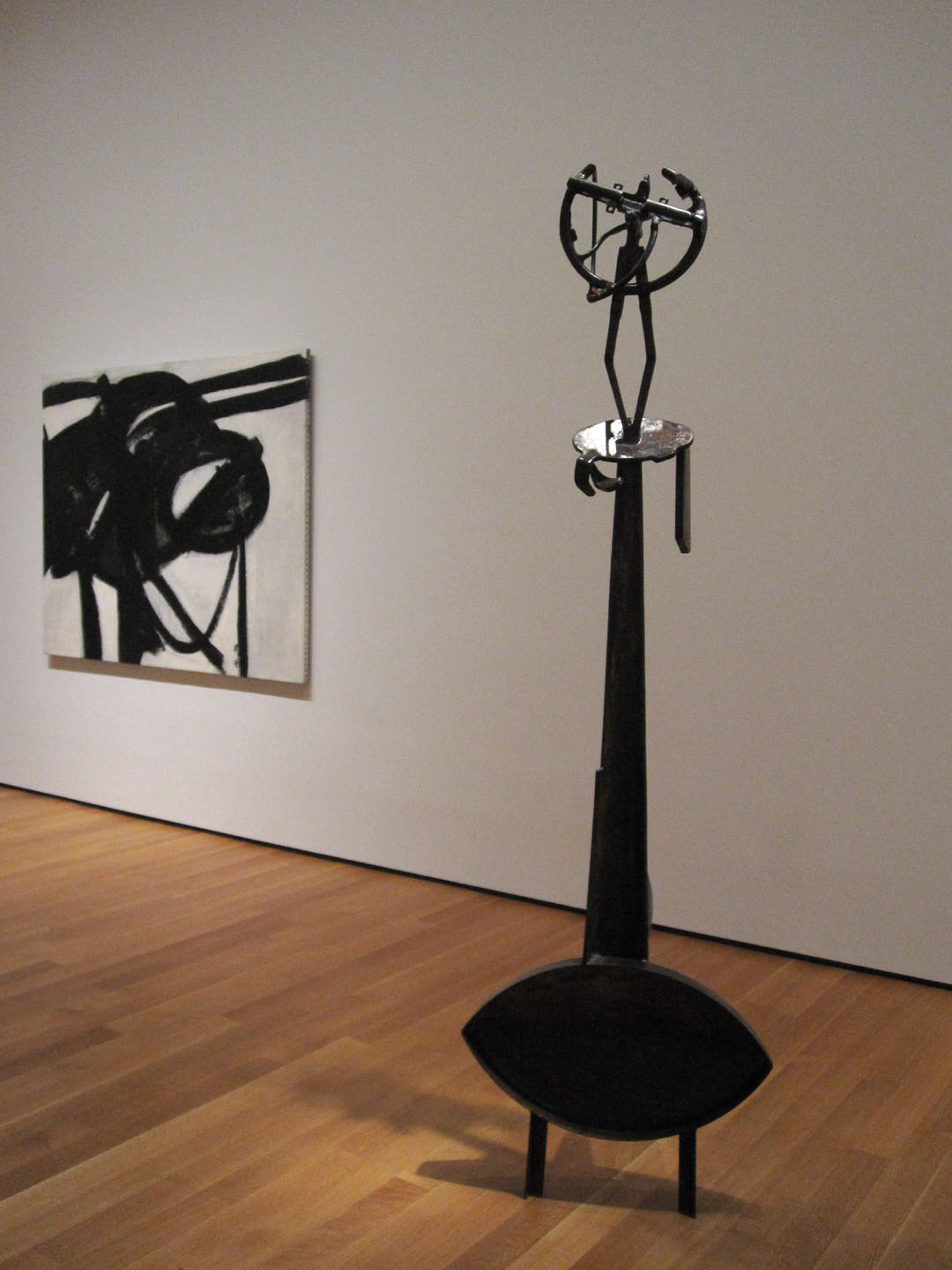
Franz Kline's "Chief" of 1950, left, with David Smith's "History of LeRoy Barton" of 1956


Franz Kline's "Painting No. 2" of 1954 with a window


13. This is something else I really liked: museum-goers, a lot of them young, were studious to the point of reverence in front of the works. It was nice to see that and it made me think that perhaps it's not all just about performing art and/or reality shows. It made me have some hope for the visual arts.


People looking at a Jackson Pollock painting. 


14.


Richard Pousette-Dart, "Desert" 1940

I liked the color and built up surface of this work. It looked as if it was oil over plaster or maybe just sand mixed into the paint.


15. Louise Nevelson - not too well represented in the MoMA collection, or at least not in evidence. But then, you really couldn't call her an Ab-Exer.


Louise Nevelson, "Sky Cathedral," 1958


16. Finally, you will never guess what that cluster of ant-like figures are doing down there in MoMA's atrium.


You'll have to watch the video that explains it all.

---------------------------------------------------------------------------------

So here we are on New Year's Eve - me at the computer and you out there having a blast or getting blasted. It's nearly time to watch the crowds in Times Square getting ready for the ball to drop. (But pullease don't make me watch Dick Clark.)


Twenty-ten has been a good year, as years go. But better days are ahead - let's hope.


HAPPY NEW YEAR to all - and to all a good night!

Monday, December 20, 2010

Arting in New York - A Report Outline

The Binster and I have had two previous expeditions in NYC this year - once in February when Central Park had just received 17 inches of snow and the city was barely open and again in July when it was about 100 degrees (F) and everyone wanted to stay indoors in the A.C. This time the weather was cold but clear and the streets were mobbed with shoppers and Christmas tourists. In certain sections of the city, it was pedestrian gridlock. Really! Luckily, Binnie is a master at the crowd clearing elbow and I just followed in her wake, keeping my eye on her and a tight grip on my pocketbook.


At Rockefeller Center with crowds, lights, flags and The Tree (click to enlarge)


Binster and the dancing bubble and snowflake show on the side of Saks' Fifth Ave. way in the background (be sure to enlarge)

Our schedule went like this:

Thursday night
Luminosity at 180 degrees - an exhibition in the Flynn Gallery at the Greenwich Public Library featuring NEW members Kim Bernard and Richard Keen plus Mark Dooley, Leah MacDonald and Martha Robinson.

Friday in Chelsea
Anselm Kiefer at Gagosian 24th St. and Robert Rauschenberg at Gagosian 21st St.
Group show at Stephen Haller Gallery
Lee Krasner at Robert Miller Gallery
Storm Tharp at Nicole Klagsbrun Gallery
Vivid: Female Currents in Painting and Pavers at Schroeder Romero + Shredder
Tomas Saraceno at Tanya Bonakdar Gallery
Plus a few other assorted galleries

Saturday Uptown
On Line: Drawing Through the Twentieth Century and ABstract EXpressionist New York - MoMA
John Walker at Knoedler
Betye Saar at Michael Rosenfeld
Judith Godwin at Spanierman Gallery
Waxing Poetic at Marymount Manhattan College featuring Willow Bader, Francisco Benitez, Marybeth Rothman, Kathleen Thompson
Macy's, Lord + Taylor and Saks' Christmas windows
Rockefeller Center

I took 420 pictures and went through two camera batteries. I only bought one catalog and didn't even go into the bookstore at MoMA.

So the plan is to make several posts about all this and show you some images from the shows. We saw some great work, some so-so work and some lousy/boring/weird/unresolved/overworked/why bother work. I guess that's just the world of art.

Monday, October 18, 2010

Abstract Expressionism at MoMA

Three of the works featured in the Museum of Modern Art's Abstract Expressionist New York, October 2, 2010--April 23, 2011.


Hedda Sterne, New York VIII, 1954, 72 1/8" x 42"


Philip Guston, The Clock, 1956-57, oil on canvas, 76"x64 1/8"


Philip Guston, Painting, 1954, 63 1/4"x60 1/8"

Monday, August 30, 2010

Icons - Part Two

I saw the work of Annette Messager and Lorna Simpson at the Museum of Modern Art in Pictures by Women: A History of Modern Photography, still on view until March 2011. This was an extensive show that brought together many well-known photographs from photography's early history to the present. I chose to write about these two works because they combine sculptural elements with photography and the works are driven by feminist considerations such as identity and women's roles in society.


Annette Messager


Annette Messager, My Vows, 1988-91, photographs, colored graphite on paper, string, black tape and pushpins over black paper or black synthetic polymer paint.


Messager is a French artist, born in 1943, best known for her installations rather than for photography alone. She works in various mediums including found stuffed animals, puppets, textiles and photography of men and women. The striking installation of the small photographs in My Vows is what attracted me to the work. The string pushpinned to the wall that suspends the photos from above is such an active part of the work and reminded me of a chandelier.


Side view of the work

Perhaps you can see better in this photo that the small photos overlap against the wall and are formed into a circle by the length of the hanging strings.

The individual photos are body parts and repeated words written in colored pencil. Two of the words that I could decipher were (in French) "silence" and "pain."


A New York Times review of Messager's work from 2007 states that Messager's intention with her work is "to free women from the roles assigned to them by men, by the marketplace, and by society. And she tries to do so through satire and caricature, using the images and materials of everyday life." 

An earlier exhibition of her work at MoMA stated that through fragmentation of images and language, Messager explores fictional storytelling that refers to the dialogue between individual and collective identity. Her work "forcefully illustrates the idea that all things -- a child's beloved toy, a photograph, a piece of embroidery, a word with seemingly unambiguous meaning -- can be transformed into objects of potent expression."

Messager shows mainly in Europe but with Marian Goodman Gallery in New York.


Lorna Simpson


Lorna Simpson, Wigs (Portfolio), 1994: portfolio of 21 lithographs on felt, with 17 lithographed felt text panels.


This was another striking piece in the show that drew me to it because of the smooth, creamy felt panels with the interesting portrayal of wigs. (The whole piece is maybe 4-5' tall by 10' wide. Each one of the wigs is roughly life size as you'll see in a later image.)  

I have long been interested in hair as a cultural element, particularly for women, and have made work about it and from it myself. Additionally, I surmised that Lorna Simpson, whom I knew to be African American, had even more issues regarding hair and culture. 


Lorna Simpson is American, born 1960, and a photographer who has usually combined her photographs with text. Working mostly in large-format studio photographs, she has chosen textual fragments that allow free association of the images with racial and sexual issues. That is, reading the text loads the images with content and associations that change the viewer's perceptions of the images.


Some of the wigs pictured in this portfolio appear to be made from Black hair and some from White hair. The text alludes to the wigs as a means of disguise, sexual attraction and an aid to crossing over gender, class and racial boundaries.


However, in this work, I found the text to be less important than the images of the wigs and their geometric arrangement on the felt panels.


In fact, I thought that the text ranged over so much territory that it was difficult to interpret Simpson's intention with this work. I actually think that the two little text panels above express her mixed feelings about it all. They say, "strong desire to decipher" and "strong desire to blur."


Perhaps it's true that hair has so many associations connected to it that it's impossible to make a succinct statement about it all.


This is the shot I really liked with the viewer in front of the work looking like she stepped right out of it.


Simpson has had a distinguished career that includes a 20-year retrospective at the Whitney in 2007, being collected by the National Gallery, MoMA, the Whitney and other top-rung museums. She also has the distinction of being the first African-American woman to exhibit at the Venice Bienniale - disappointingly not until 1997. You can see more of Simpson's work here.


Saturday, August 21, 2010

I See Some Icons and Call Their Name: Part One

I was undecided about raising the specter of "Feminist Art" in this post. Originally I was just going to say "Icons of Art," but then I started doing a little research on the artists who made the works and saw how strongly they were all linked to feminism in one way or another. So I'm just going to grab the bull by the horns and spit out Feminism. (And not in a bad way.)


Detail from "Some Living American Women Artists"


I'm not calling the works in this post "feminist art" because I don't want to limit them that way. I will say that they are related to or inspired by ideas that arose from the original feminist movement. However, Mary Beth Edelson's "Some Living American Women Artists" is probably the poster child for feminism because it challenged male authority in religion and art at the same time. Edelson also dared to mess with the sacrosanct image of The Last Supper (appropriation of the masterpiece) and paste the head of Georgia O'Keefe atop the body of Jesus Christ. (By the way, I made these images even bigger than usual, so if you click on them, they'll open larger and I hope you can see more.)


This work, created in 1972, before PhotoShop, in the cut-and-paste era, is included in "Pictures by Women: A History of Modern Photography" at the Museum of Modern Art, New York (May 7, 2010–March 21, 2011). As an object, it has aged well in that it's become even more interestingly unusual since we don't get to see such rough-looking collage today with little, hand-cut, typewritten labels and such a variety of image sizes and colors. Even its overall size seems to date it in that it's not monumental. What I'm getting at is that it really looks handmade and like a relic of the feminist movement that has survived for 38 years. It looks like an icon.


Detail of left side showing Helen Frankenthaler, June Wayne, Alma Thomas and Lee Krasner (all that I can read in my photo)


Detail of center showing Georgia O'Keefe, Louise Nevelson and  M.C. Richards


Detail of right side showing Louise Bourgeois, Lila Katzen and Yoko Ono


Perhaps you may view this work as just an interesting historical piece and record of feminist objectives of the era, however, on Mary Beth Edelson's website, an essay  by Linda S. Aleci relates a 1995 controversy about a poster of the work that hung in a women's center at Franklin and Marshall College. There eight faculty members complained that the work was an "affront to Christian sensitivities" and called for censure of the women's center and its executive board. The debate was revived at Franklin and Marshall in 2000 when Edelson's works were exhibited at the college art museum. The claim was made that Edelson's collage was '“a work of art that makes a point about women artists at the expense of Christianity's most sacred symbols“–an interpretation that coyly sidesteps the theologically problematic inference that a reproduction of Leonardo's fresco constitutes the ontological manifestation of the Last Supper."

During the exchange of protesters and defenders of the work at the college's women's center, one critic charged that Edelson's "offence" could be compared to "acts of defacement like 'putting a pig's head over the picture of Martin Luther King, Jr.'" Continuing with a quote from the essay:

To assert that the remaking of a figure in the image of a woman is comparable to remaking a figure in the image of a pig, an animal associated with filth, is to describe women as profane, unclean, degrading creatures. From this one understands the truth of Some Living American Women Artists: it is indeed the entity Woman–embodied in the faces of actual women–that continues to be regarded with horror. And it is a timely reminder. One month after the controversy first erupted at F&M, the Vatican's Congregation for the Doctrine of the Faith issued a statement upholding the ban against the ordination of women as priests as infallible doctrine.

________________________________________________________
Slight Tangent
I had never heard of Franklin and Marshall College, but it's a small liberal arts college located in Lancaster, PA. I thought from the description of the controversy that it might be a Christian school or bible college, but No. Here is its mission statement

Franklin & Marshall College is a residential college dedicated to excellence in undergraduate liberal education. Its aims are to inspire in young people of high promise and diverse backgrounds a genuine and enduring love for learning, to teach them to read, write, and think critically, to instill in them the capacity for both independent and collaborative action, and to educate them to explore and understand the natural, social and cultural worlds in which they live. In so doing, the College seeks to foster in its students qualities of intellect, creativity, and character, that they may live fulfilling lives and contribute meaningfully to their occupations, their communities, and their world.
________________________________________________________


When I was in art school in the 1980s, I was heavily involved in feminism, paganism, and any other -ism I could get my hands on. I loved the work of Mary Beth Edelson, who was mainly doing performance at that time and worshipping the Mother Goddess and the eternal feminine through her own body. Today Edelson is in her late 70s and apparently still going strong. Here's a link to her website that shows the timeline of her life juxtaposed with cultural and political events. You can also see the various bodies of artwork that she has made.

Edelson was instrumentally involved in creating "WACK! Art and the Feminist Revolution," a traveling show at P.S. 1 in New York in 2008 and the Museum of Contemporary Art in Los Angeles in 2007. This show surveyed "feminist art" from 1965-1980 and was well received for the quality of the work chosen. (A contemporaneous exhibition of "feminist art" called "Global Feminisms" also appeared in 2007. I saw it at Wellesley College and was less than enthusiastic about the work in this show that seemed stripped of all its passion, humor and enthusiastic embrace of making a new place for women in the world.) An interview with Edelson in the spring 2008 P.S. 1 newspaper gets her talking about her past and the future of feminism.


A face I recognized - a young Lee Bontecou at the bottom left


Edelson had trouble with spelling Bonticou's name (no. 13)


How did Edelson choose the artists to include in her last supper? She says that she did not personally know these artists and the selections were "fairly arbitrary" in that they were not political associations but chosen to show diversity of race and artistic mediums. "The border included every photograph of a woman artist that I could find, with most of the 82 photographs coming directly from the artists themselves." (from the essay on Edelson's website) As for Georgia O'Keefe being chosen for the Christ spot, Edelson thought that because of her artistic success and recognition, O'Keefe deserved to be honored with the central placement.

Edelson's famous work still seems totally relevant today - not only are women artists still fighting for representation and recognition but religious bigotry is rearing up all over the place. Religious fears and fundamentalism are driving new and more vehement protests against diversity of any kind, and if Edelson were to create this work today, she would probably engender picketing by right-wing zealots similar to those at Franklin and Marshall College. It's a weird world we're living in where lies and accusations become accepted as fact purely because they're asserted and repeated often enough to become the norm. Have a look at a little different view of things by Mira Schor.

Addendum
Please don't get me wrong: I am not opposed to feminism but I am opposed to "feminist art." I think that term is dismissive and ghettoizing. The term "feminism" has had a bad rap for the past few years, similar to the word "Liberalism." I'm claiming them both as describing my beliefs.

Following definitions via dictionary.com
fem·i·nism   [fem-uh-niz-uhm] –noun
1.the doctrine advocating social, political, and all other rights of women equal to those of men.
2.(sometimes initial capital letter) an organized movement for the attainment of such rights for women.
3.feminine character.

World English Dictionary
feminism - a doctrine or movement that advocates equal rights for women

Collins English Dictionary - Complete & Unabridged 10th Edition
Word Origin & History
feminism
1851, at first, "state of being feminine;" sense of "advocacy of women's rights" is 1895.
Online Etymology Dictionary, © 2010 Douglas Harper


lib·er·al·ism   [lib-er-uh-liz-uhm, lib-ruh-] –noun
1.the quality or state of being liberal, as in behavior or attitude.
2.a political or social philosophy advocating the freedom of the individual, parliamentary systems of government, nonviolent modification of political, social, or economic institutions to assure unrestricted development in all spheres of human endeavor, and governmental guarantees of individual rights and civil liberties.
3.(sometimes initial capital letter) the principles and practices of a liberal party in politics.
4.a movement in modern Protestantism that emphasizes freedom from tradition and authority, the adjustment of religious beliefs to scientific conceptions, and the development of spiritual capacities.