Ever so long ago, in mid-July, this was the way we spent our Saturday in New York - visiting the McQueen show at the Metropolitan Museum and the Cone Sisters exhibition at the Jewish Museum. I have to hand it to myself for having the persistence to continue with posting about this trip because I've dragged it out so long. Nevertheless, I'm determined to finish. (click pix to enlarge)
Metropolitan Museum
We (Binnie Birstein, Greg Wright and I) started off the day with an early train to NYC from Connecticut. When the cab dropped us off in front of the Met, there was a long line waiting to get into the museum. We raced upstairs to the McQueen line as soon as we entered, but the crowd behind the ropes waiting to get in was already in the hundreds. Greg and I were dismayed (to put it politely) and would have given it up, but the Binster was determined.
 |
| Crowd waiting for entry to McQueen show (image from the internet) |
She decided that she would wait in line while Greg and I looked at exhibits downstairs and she would call us when she reached the doorway. Although we didn't really agree, she was not to be moved, so Greg and I went about our business.
 |
| Greg with the Ancient Greek krater showing a painter applying encaustic to a statue of Herakles |
The first stop, but of course, was the krater of the encaustic painter that Greg had not seen in person before. He was so happy to be there. You can see that he is beaming.
 |
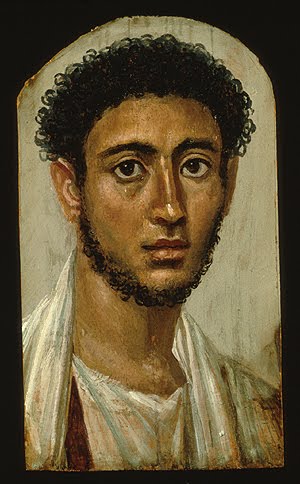
| Greg with the Fayumn portrait of the boy Eutyches |
 |
| In this photo, Greg seems to have turned into a Fayum portrait himself |
Anyway, we happily visited several galleries in the antiquities wing for an hour or so while Binnie waited upstairs in line. Then we went to an information desk to ask where the exhibition of Richard Serra drawings was located. While we were standing there waiting, I noticed a sign that said if you joined the museum, you and all the members of your party could be admitted to the McQueen exhibit without waiting. I was incredulous and made sure that I was reading it correctly. Why hadn't we known about this before? Membership was $70 and Greg and I agreed to split the cost. We stood in another longish line to get a membership and with our temporary pass, we texted Binnie. She met us upstairs and we went into the exhibition with the membership pass.
Alexander McQueen, "Savage Beauty"
“You’ve got to know the rules to break them. That’s what I’m here for, to demolish the rules but to keep the tradition.” - Alexander McQueen
Was it worth the wait and the $70 is probably what you're wondering? Overall, I would say yes, it was. I am certainly no fashionista and Project Runway is the closest I come to being concerned with fashion, however, I do think that McQueen was an artist who was closer to a sculptor than a designer. His mastery of tailoring was superb, but more than that, his imaginative innovation in conception and use of materials was quite incredible. Following are some examples.
 |
| Dress made from shellacked razor clam shells he first found on a beach. |
 |
| Dress made from medical slides stained to look like blood on top and dyed ostrich feathers feathers on the bottom |
 |
| Coiled corset made from aluminum 1999-2000 |
 |
| Dress of woven leather, neckpiece of pheasant feathers with resin vulture skulls |
 |
| Leather shaped corset with horsehair skirt |
 |
| Spine corset made of cast silver |
Here is an 8-minute video narrated by Andrew Bolton of The Costume Institute, curator of the exhibition. This will show you the exhibition gallery by gallery. (For more photos of each gallery and info on the designs, here's the link to the Met's blog on the exhibition.)
Seeing the exhibition was not a great experience in that it was so crowded that it was hard to get close to the pieces and see the detail. It was also much darker than in the video and I found the soundtrack annoying. But despite all that, I am glad I saw it. I had no idea of who he was or what he had accomplished in his short, rather sad life.
 |
| Isabella Blow with Alexander McQueen early in the fashion game |
One blog (which apparently is stronger on fashion than punctuation) gives his story as follows: "Son of a taxi cab driver he dropped out of school at age 16 and went to work on Savile Row as a cutter and tailor at : Anderson & Sheppar, Gieves & Hakes and then Romeo Gigli. McQueen finished his education and graduated in 1994 with a Master’s degree in fashion design from London’s Central Saint Martins College of Art and Design. Isabella Blow legendary fashion guru discovered Alexander and purchased his entire graduating collection, which helped him make industry connections."
 |
| By 2006, he had markedly changed his appearance and was dressing and hobnobbing with fashion icon Sarah Jessica at a Met gala |
When I saw the shoes and hair from his spring 2010 collection (image below), I couldn't believe it and actually wrote a blog post about how horrifying I found it. However, seeing everything in context makes me understand it better, even though I still think those shoes are pretty devastating.
 |
| Spring 2010 collection on the runway. The lobster claw shoes horrified me. |
Greg and I went through the exhibition together and looked pretty closely at things. We noticed that the first dress in the shot above was called the "bee dress" and I found an image of it by itself (this gallery was about the influence of Nature on McQueen).
 |
| The gold-colored hexagons on the hips are separate paillettes |
Alexander McQueen committed suicide at age 40 on February 11, 2010, shortly after the death of his mother. R.I. P.
Read the NY Times story about the final few hours of the show here.
“Fashion should be a form of escapism, and not a form of imprisonment, I wasn’t born to give you a twin set and pearls.” - Alexander McQueen
Read the NY Times story about the final few hours of the show here.
“Fashion should be a form of escapism, and not a form of imprisonment, I wasn’t born to give you a twin set and pearls.” - Alexander McQueen
 |
| Claribel, the eldest and one of the first female doctors, and Etta Cone |
The Cone Sisters at the Jewish Museum: Collecting Matisse and Modern Masters
After a visit to the sculpture show on the Met's roof (underwhelming), a brief rest and then an incredibly expensive but tiny lunch in the Met's restaurant, we hiked it up to the Jewish Museum to see an exhibition about the Cone sisters' collection.
Etta bought the first five paintings in 1898 to decorate their apartment, but after the sisters met Gertrude and Leo Stein, they discovered Matisse in Paris in 1905, began collecting his work, and eventually owned 500 of his works, making theirs the largest and most comprehensive collection of Matisse's works in the world. On their death, the collection was donated to the Baltimore Museum and that museum has put together the loan of 50 pieces for the show at the Jewish Museum.
The Cones also collected about 100 works by Picasso and had extensive collections of lace, textiles and jewelry. This was another very crowded exhibition and it was difficult to see the works. The most interesting part to me was not the paintings but the jewelry and the handwritten letters between the sisters and with Matisse and Picasso. There was also a short film about the sisters, their relationship with Matisse and their collection. This show runs until September 25th so there is still time to see it. Here's another good link.
Maira Kalman
After looking around the rather compact Cone exhibition and seeing the film, we went upstairs to an exhibition of works by Maira Kalman. I like her witty drawings and ironic commentary but I have to say that I was about done in by the time I got there.
Viewing her work and the collection of objects she put together required some intimate looking, ironic interpretation and a lot more attention than I was capable of giving, so I'm afraid I really couldn't do it justice, but if you are a fan of Maira's, you probably would have loved it because there are many small works to look at. Unfortunately, it ended July 31st.
And so, dragging ourselves slowly and reluctantly in the heat, we made our way to a coffee shop where Greg and I told Binnie we wanted to cut our plans short and go home to Connecticut. We are just not the troopers that the Binster is, and that's all there is to it. Luckily, we revived enough after the train ride to have dinner in Binnie's favorite Chinese restaurant before we called it a day.
Etta bought the first five paintings in 1898 to decorate their apartment, but after the sisters met Gertrude and Leo Stein, they discovered Matisse in Paris in 1905, began collecting his work, and eventually owned 500 of his works, making theirs the largest and most comprehensive collection of Matisse's works in the world. On their death, the collection was donated to the Baltimore Museum and that museum has put together the loan of 50 pieces for the show at the Jewish Museum.
 |
| Matisse: Interior, Flowers and Parakeets, 1924, part of the Cone collection |
 |
| Matisse: Large Reclining Nude, 1935 |
The Cones also collected about 100 works by Picasso and had extensive collections of lace, textiles and jewelry. This was another very crowded exhibition and it was difficult to see the works. The most interesting part to me was not the paintings but the jewelry and the handwritten letters between the sisters and with Matisse and Picasso. There was also a short film about the sisters, their relationship with Matisse and their collection. This show runs until September 25th so there is still time to see it. Here's another good link.
 |
| The Cone sisters' apartment showing their extensive collection of art |
Maira Kalman
After looking around the rather compact Cone exhibition and seeing the film, we went upstairs to an exhibition of works by Maira Kalman. I like her witty drawings and ironic commentary but I have to say that I was about done in by the time I got there.
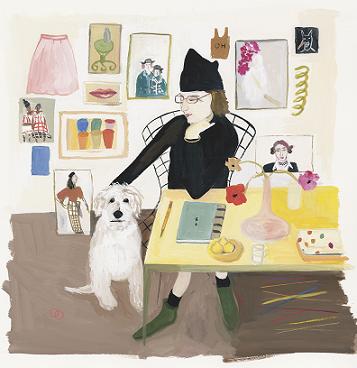 |
| Maira and Pete by Maira Kalman |
 |
| Maira has done many covers for The New Yorker and writes a blog for the magazine |
Viewing her work and the collection of objects she put together required some intimate looking, ironic interpretation and a lot more attention than I was capable of giving, so I'm afraid I really couldn't do it justice, but if you are a fan of Maira's, you probably would have loved it because there are many small works to look at. Unfortunately, it ended July 31st.
And so, dragging ourselves slowly and reluctantly in the heat, we made our way to a coffee shop where Greg and I told Binnie we wanted to cut our plans short and go home to Connecticut. We are just not the troopers that the Binster is, and that's all there is to it. Luckily, we revived enough after the train ride to have dinner in Binnie's favorite Chinese restaurant before we called it a day.