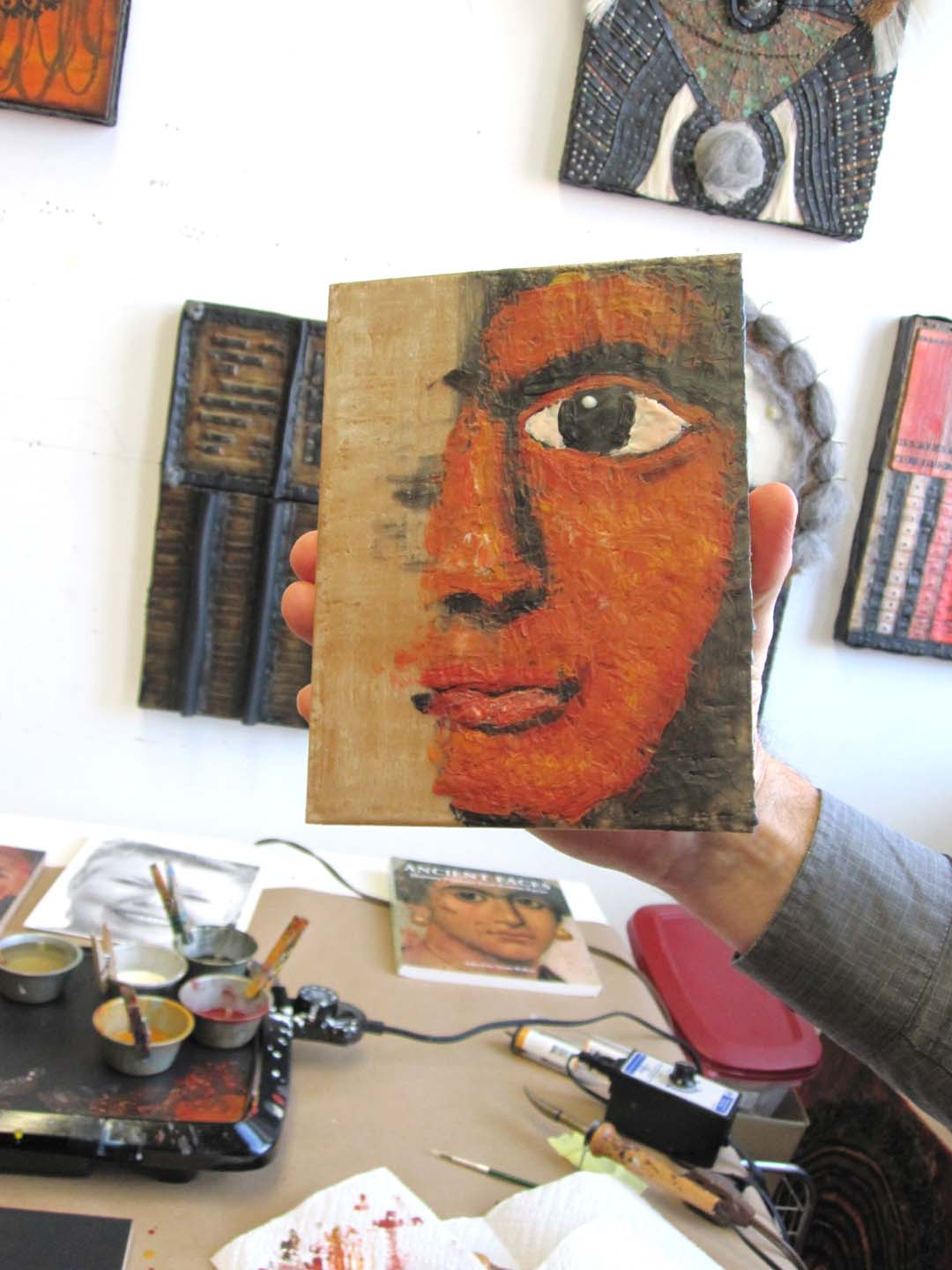
Whew! What a lot of work I put into the encaustic class I taught for Smith College this past week! I worked very hard getting ready for the demo and Power Point on Tuesday and then the hands-on class on Thursday, but I think it was worth it. All the students seemed to really enjoy learning about this great medium and its history as well as getting to experiment with it themselves.
It suddenly dawned on me as I was setting up that this was a huge class for teaching encaustic. Somehow when I was buying materials for 12 students, I never thought about that many people all waxing away at once. Actually there were more painters than that because some faculty joined in too.
The details: I made medium from 10 lbs of beeswax plus 2 lbs of damar resin. Then I filled 36 tins with medium and added small pieces of pigmented paint to them for the colors. Each of the four heated palettes (griddles) had six R&F Paint colors (Rose Madder, Azure Blue, Ultramarine Blue, Alizarin Orange, Cadmium Yellow Light, Cadmium Green Light) plus Titanium White and Ivory Black. Each also had a deeper tin of clear medium. Each tin had a 1" brush and the medium also had a 2" brush.
Each of the 12 place settings had a 6"x6" panel and a 6" x 8" panel, with one of the two panels painted with R&F encaustic gesso. Each also had two pottery tools (one for scraping and one for incising) and three 1/2 brushes. There was also a container with 144 smaller brushes and boxes of larger brushes.
I set up two 4'x8' tables, each with three places on each side and two palettes. Heat guns were located at both ends of each table. I also had a separate station with a frying pan of medium and another heat gun. And I had a resource table with xerox copies, texture materials, pigment sticks, an iron, etc., etc. There were also the tops of the paint tins for mixing colors in. I had several uncradled boards, too, that fast workers could use if they covered both their panels.
People dug right in and started their projects. Everyone seemed to have plenty of ideas to keep them busy.
They didn't seem to need much help from me although I walked around and looked "available". I guess this was what I found to be the most difficult part of teaching - the not being needed part. What do teachers do during this part of a class? I really never thought about it before.
The three-hour class passed by pretty quickly until it was time for clean up and review of the work.
It was pretty surprising that the work varied so much from one piece to the next. These students were not artists, by the way, but mostly art history majors. This class is part of the Museum Studies program.
Apparently I missed taking photos of all the students, but I think I will be getting a copy of a short video taken by David Dempsey, teacher of the class.
And here is David Dempsey, conservator and preparator for the Smith College Museum. He developed quite an ambitious program for this course in Materials and Methods of Art, which is being taught for the first time this spring. The course syllabus is pretty amazing and takes students all the way from the manufacture of raw materials of art, through supports and tools, and then into mediums or practices such as encaustic, fresco, tempera and distemper, watercolor, oil, charcoal, relief printing, marbling and gilding. This is a course I wish I could take!
So a fun time was had by all, I learned a great deal by stepping up to this challenge and now I'm glad to get back to my own head and a quiet (and clean) studio.