Showing posts with label DeCordova Museum. Show all posts

Friday, October 1, 2010

Leonardo Drew at the DeCordova Museum

A year or so ago, Gwen Plunkett from Houston, a friend I had met at the encaustic conference, posted some images on her blog from a show at the Blaffer Gallery at the University of Houston. The images were of work by Leonardo Drew from "Existed," a show that had been organized at the Blaffer. When I learned that a large-format book had been published as a catalog of this show, I ordered one immediately, and since then I have been a Leonardo Drew (LD) fan, as you probably know if you follow this blog. All year I've been waiting for September 25th when LD himself was speaking at the much smaller installation of Existed at the DeCordova Museum in Lincoln, Mass. (September 18, 2010 to January 9, 2011)


The grand staircase at the DeCordova (not sure of exact name they call it) showing an installation by LD. (Click to enlarge)

No matter how many curators, critics or commentators talk about or explicate an artist's work, there is nothing like hearing it from the artist him- or herself. This was such a treat for me to meet LD in person and hear what he was thinking when he made the work and how one piece related to another.


Looking up at the staircase wall as I ascended

First of all, photography is not allowed inside the Museum, but how could I know that? So I snapped some pics of the installation as I went up the stairs.


LD says that he never throws anything away and that he takes apart older work to make new objects. The pieces in this installation look like they came from his No. 123, but they could have come from anything.


LD said that he installed this work along with the crew from the museum. They were working on scaffolding and did not have an advance plan. The work was installed intuitively and from LD's experience.


I thought it was pretty interesting to see the juxtaposition of some very finished elements and some things that look like they came from the lumber scrap pile - as you can see in the photo above.


Having the work in the stairwell was actually great for getting up close, as I like to do.


Looking down the stairway from the top.


LD said that he organizes an installation like this by feel or visual weight - what is heavy, what is light.


No Photos Allowed
So once I got to the top of the staircase, I came face to face with two pieces.


This one looked to me like part of No. 75, from 2000. The original No. 75 was a giant piece but this segment was only about 6' x 6'. I'm judging that because I think that the modular panels he uses are 24"x24". The number of disparate objects that he used in this piece was unbelievable. (Don't forget to click to enlarge.) I made a list of what I observed and found that a lot of it was broken children's toys or equipment. Childhood seems to be a real throw-away time when you think of it, such a transitory period.

I believe that this kind of collecting of objects for LD came about when he was an artist in residence in Brazil and sent out 100 children with trash bags to see what they could find on the streets. However, LD himself is a perennial street cruiser and says he goes out with his shopping cart all the time to see what he can pick up. Many artists do this, of course, and you can just imagine all the shopping carts cruising around in parts of Brooklyn to see who gets to the trash first. I used to love doing this when I lived in the city and even out here in the boondocks I've found some stuff - and I do have my own shopping cart.

After I took the photo of the piece above, a guard came up to me and told me to stop taking photos.  So I didn't get to take an image of No. 59 that was also hanging in the lobby area, but I did examine it up close to see how it was made. I was taking copious notes and felt like I was getting ready for an exam. This was the only work of LD's that I had seen in person except for his show at Sikkema Jenkins last February and that work was very different - much larger scale elements, very little rust, more wood of all kinds and shapes, I would even say more brutal and more physical. It had a very different feeling. You can see and read about what I said here.

The Man Himself


Leonardo Drew speaking to the crowd of 40 or 50 at DeCordova. Behind him is No. 28 from 1992.


I thought LD was great. He spoke in the gallery with his work and walked around from one piece to another but not in a programmed way. He spoke in a non-pretentious, direct manner and was willing to entertain all kinds of questions. He even talked to us about process - which he said he usually doesn't - and the best thing about him was his infectious laugh.


LD with a curator gesturing to No. 94 from 2005  - cast paper objects hanging by paper-covered ropes from a painted piece of wood.

He said that he liked seeing the show because he doesn't get to see his work too much after it leaves the studio. He works on many pieces at once (he said 7 pieces) and "they're all like crying babies" in that they're all looking for attention and help. Then "they get legs and go out in the world and have their life."

The History of His Work
Sure, I read all this before, but it never sunk in until I heard him tell the story directly: after he graduated from Cooper Union in 1985, Drew experimented with various types of work. In 1988 he made No. 8, which he calls the "mother piece." (By the way, initially he titled all his work but changed to a numbering system because he wanted a more pure reaction by viewers.) To make No. 8, he went to "The Dark" within himself. He said he doesn't remember feeling that dark, but it came from somewhere inside so that No. 8 has a heavy, brooding sensibility. In this piece, he put scavenged dead birds and animals he found on the streets along with all kinds of remnants and hunks of discarded things and he painted it all black. He said that this was the only time he's ever included dead things in his work and did it this once to get over his fear and get past it.


No. 8 , 1988 - 108"x120"x4" (from the DeCordova website)


Detail in No. 8 (shot from Existed catalog)


Two years later, LD made No. 14 - the first time he used rust in his work. Drew owns both No. 8 and No. 14 because they are seminal works for him.


No. 14, 1990 - 103" x 83" x 1/8" - shot from Existed

This is a large slab of rusted metal, or more than one slab, not attached to any wooden support.


Then four years later, in 1994, LD combined No. 8 and No. 14 to make No. 43 by using "the material mass" from No. 8 and the surface from No. 14. He says it "was not just the combination of materials, but of ideas." He believes that these ideas are "already in your body, like DNA."  There is "some form of history that flows through each of us and then comes out. Then we have to move on." He says that the progression of his work came organically as he worked through one form to another. He has noticed that "the more he touches things, the better they get."


No. 43, 1994 (from DeCordova website), babric, plastic, string and wood, 138"x288"x12"


Closeup of No. 43 from Existed catalog


The Grid
LD said that he made 1200 boxes for No. 43 and then he had to figure out what to do with them.

Notice that No. 43 also is based on a grid that LD said he began using first for practical reasons - it allowed him to make modular work that could be stacked, compartmentalized and moved out of the studio. He says that it's a device for him, a means to an end. (And also calls it his nod to minimalism.)

He uses it now to make modular panels with attached parts. For example, below is a piece from his February 2010 show at Sikkema Jenkins where the grid is a very big grid of panels.


The grid has been useful for him in moving the work and in reassembling it in various museums and galleries as it travels around. He can reconfigure work depending on the space, and he himself always figures it out with the curators. He has a very hands-on attitude toward his work. (By the way, if you go to the DeCordova to see this work, there is a time-lapse video of this exhibition being unpacked and installed that shows how much work went into getting it to look seamlessly hung. You will see LD throughout.)


It's no accident that LD is wearing a shirt with a cartoon figure. He got an offer at age 15 to work for DC Comics (plus being courted by Marvel Comics and Heavy Metal magazine) because he was such a skilled draftsman. He was lucky enough to be recognized and encouraged early in his life for his artistic skills, but instead of becoming an illustrator, he was inspired by reproductions of Jackson Pollock's work to aspire to another vision of art making. (He relates his No. 8 directly to Pollock's work.) The 1980 Picasso show at MoMA was a big influence and a 1983 trip to Europe introduced him to the work of Joseph Beuys, Christian Boltanski, Alberto Burri, Anselm Kiefer, Jannis Kounellis and Antoni Tapies. Art for him became about "materials as markers of cultural history" (Claudia Schmuckli in the introduction to Existed).

LD said that he began as a painter and so his work almost always connects to the wall; freestanding work is "an anomaly" for him. (But interestingly enough, he builds his work on the floor, not on the wall.) For most of his career, decay of one form or another has been a big part of his work, and he has created that decay himself by treating the objects. Now he is working with found objects such as "monstrous roots - emphasis on monstrous" from the Napa Valley. He says this makes the work go much quicker because he doesn't have to make everything. The show he's working on now is three years distant and he does most of the work himself ("I don't have slaves").

I found him personally as inspiring as his work and am grateful to the DeCordova Museum for giving us all the opportunity to hear Leonardo Drew speak.

Thursday, August 26, 2010

A Few of My Favorite Things

After a nearly 12-hour day yesterday of working for money, I'm headed into the studio today to continue work on my new series. It's mixed media with encaustic and the encaustic is fused with a heated tool called a shoe (because it looks like a shoe or a boot). I'm excited about it and will be posting images soon.

Meanwhile, I wanted to update you on some of my favorite things.


The whole ball of wax via The Encaustic Conference blog


Where's Joanne?
In case you missed it, Joanne Mattera posted a new comment the other day on my Where's Joanne? post that related the latest event in the contretemps over Montserrat College of Art touting themselves as "the epicenter of encaustic." A local TV feature that Montserrat regarded as putting them in this position of prominence failed to even mention Joanne's name as the organizer and director of the encaustic conference, yet Montserrat linked to the TV piece and did not try to correct their egregious error. Here's Joanne's comment:

Everyone,
I thought you might like to know that as of today the the college removed the link to the offending video. A number of artists, myself included, had suggested that removal might be a good faith gesture. I'm pleased to see it gone. I think it means we can all move on--they on their own path, we on ours.AUGUST 24, 2010


Joanne is now organizing the next encaustic conference - Number Five - that will take place at a yet-undisclosed location that is not Montserrat. Stay tuned for the big announcement and, meanwhile, get the latest at Joanne Mattera's The Encaustic Conference blog, where ARTISTS CHANGE EVERYTHING.


Joan Mitchell, Ladybug, 1957, oil on canvas, 6'5" x 9'
'
Abstract Expressionism Makes a Comeback
You know how I like reading about those guys (mainly guys) from the '50s and '60s, well this morning  I saw a link that Mira Schor posted on Facebook to an article from August 17th in Lindsay Pollock's Art Market Views about a show being curated by Ann Temkin at the Museum of Modern Art this fall. Called The Big Picture: Abstract Expressionist New York, the show will take over MoMA's fourth floor and include 300 works by 40 artists, some well known and some not, but all from MoMA's extensive collection. Check out the link that provides a list of artists and works. This looks like a gotta be there show.


Be Careful When You List the Twinkies
And while I was looking at Mira Schor's link, I found a comment from Adriane Herman that posted something from the Archives of American Art at the Smithsonian. Who knew what stuff they have in there! This is Franz Kline's grocery list crica 1962.


Catherine Carter, work in progress


A painter's moods
Then I saw a post from Catherine Carter about how mood influences painting. Oh, yeah. I've been there: the ups, the downs, the doubt, the enthusiasm - all in a day's work.


Artist's conception of the new Sperone Westwater building


The actual New Museum of Contemporary Art - right down the street from Sperone Westwater


Are We Moving Again?
Ever notice how artists precede gentrification? We are the pioneers. Who else would put up with the cheap but crappy places to live and work? But then when the money moves in, the artists get the boot. O.K.Harris Works of Art on Facebook linked to the Bloomberg story about the 20,000-square-foot, Norman-Foster-designed, new building that Sperone Westwater Gallery is constructing on the Lower East Side near the New Museum.

An excerpt: what it is and what it will be:
Most Lower East Side dealers rent modest spaces at prices ranging from $50 a square foot on Delancey Street to $200 a square foot on Bowery.

Excluding Foster’s fee and the $8.5 million Sperone Westwater paid for its narrow lot in May 2008, the building cost about $580 a square foot, or $11.6 million, according to Vincent Vetrano, president of construction consulting firm Wolf & Co. Around the same time, a 27,000-square-foot building in Chelsea was listed for $20 million (it sold in March for $8 million).


The pendulum swings and the focus of history moves on.


A work by Leonardo Drew that I photographed in New York last February. Unfortunately I don't have the number/title.

Thinking About September
It means more than school starting and falling leaves to me. It's also the month when Leonardo Drew's Existed  exhibition opens at the DeCordova Museum in Lincoln, Massachusetts (September 18 - January 9). This will be the only venue in the northeast and Drew will be giving an artist talk at the museum on September 25th at 3:00 p.m. (And this week is the last week of the Chakaia Booker exhibition at DeCordova. It ends this Sunday, August 29th.)


San Francisco in 1900 - see it live via the link below


A Glimpse of Another World
What was San Francisco like in 1905? Take a 7-minute ride on a trolley car and get a sense of it all.


And now, back to the studio...

Sunday, April 4, 2010

"Manna" at the DeCordova Museum

Blogger's Note: In this season of religious celebration for many, I thought I would offer a modest shout-out to the original religion. Apologies to any who are offended. You can stop reading here if you think you were first in line.
---------------------------------------------------------------------------------


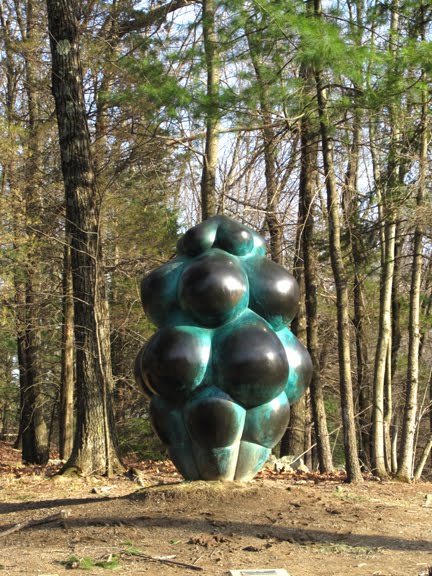
While I was walking over to view the Chakaia Booker sculptures at the DeCordova Museum, I spotted this lovely piece nearby.


This is Manna , 2007, Bronze, 6’7’’x 5’x 5’,by Tom Chapin. 


This striking piece was so evocative of ancient cultures and yet looked entirely contemporary. I just loved it. The form and the beautiful color that came from weathering appealed to me so much.


Here she is in the sculptor's studio before being exposed to the elements.


The DeCordova website has this to say about Manna:  


Although Chapin typically carves from stones as diverse as marble, limestone, and jade, Manna is made in bronze. Reminiscent of Neolithic fertility statuettes like the Venus of Willendorf, Manna makes reference to the duality of base desires and the richness of life sustaining gifts. Chapin uses five sets of five orbs to create this five sided structure as a mathematical reference to pentagonal symmetry. The plump and primal figure reflects the artist’s interest in both the complexity and beneficence of the universe.


Sculptor Tom Chapin, born 1954, lives and works in Phippsburg, Maine.


The work on Tom Chapin's website is just beautiful. I can see the influence of so many ancient cultures in his work, but it has an organic simplicity and elegance that is all his own.


Manna's influences
By this I mean that I assume these are some of the influences. They are actually what I was reminded of when I saw Manna.


"Venus" of Willendorf, found in 1908 by the archaeologist Josef Szombathy above the Danube river near the town of Willendorf in Austria. The statue is only a little over 4" tall and is carved from a type of limestone not found in that area. It is currently dated to around 24,000-22,000 BCE. (All these so-called fertility figures were called "Venus" after the Roman goddess of beauty.)


Back in the 1980s I was heavily influenced by my studies of ancient goddess figures, so of course I saw in Manna not only the Venus of Willendorf, but the many-breasted Artemis of Ephesus. 


Apparently worship of Artemis was either a very popular religion or the religion was fortunate in having many representations survive as there are many recovered statues similar to this. I saw one in the Vatican Museum and another at the Archeological Museum in Naples. (I like the Naples one because of the black hands and face - see below.)


I really had an LOL moment when I read this description of the breast-shaped objects protruding from her chest: "One of Artemis' characteristics is that she protects fertility. This may be symbolized by the spherical objects that cover the lower part of her chest, but the common assumption that they are female breasts is incorrect. They probably represent the testicles of a bull, although they may also be gourds, which were known in Asia as fertility symbols for centuries."  (www.livius.org/ei-er/ephesus/ephesus_artemis.html)


Come on! When was the last time that bulls' testicles protruded from a woman's chest? Perhaps it would be more appropriate to say that the priests of Artemis wore bulls' testicles or gourds to represent breasts, and that gourds were considered fertility symbols (just as other melons are) because they represent breasts!


Well, anyway, Manna also reminded of one of my original sculpture faves, Gaston Lachaise, who created buxom statues as inspired by his full-figured wife, Isabel.


Standing Woman, 1932, bronze, 88 1/2"H, Gaston Lachaise. No doubt you have seen this work at MoMA. I always thought it was so regal and imposing. She is truly a goddess.


Here are some other Lachaise figures:


Torso of Elevation, 1912-27, bronze, 48" high.


Standing Nude, 1921, bronze, 11 3/4" high.


Torso, 1928, 9 1/2" high.


In this last image you can see that Lachaise came very near to making his own Venus of Willendorf. Of course he suffered for his daring work and was condemned as vulgar.


Which brings us back full circle to Manna. Tom Chapin referred in his statement on Manna to the "duality of base desires and the richness of life sustaining gifts." I think that in depicting the sexual characteristics of women, this duality is inescapable. Through his indirect depiction or allusion and by invoking mathematical perfection, Tom Chapin avoids getting caught up in this controversy and brings his work to a state of iconic contemplation of the female.