Thursday, September 3, 2009

Studio Visit With Myself

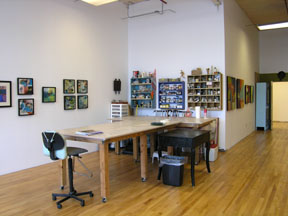
I checked in with Joanne Mattera's blog and enjoyed seeing a report of her studio visits to Pam Farrell and Steven Alexander - two of my favorite artists. Looking at studios is always fascinating to me and one of the main reasons for this blog. So I thought I would post a few images from my own studio that I took last Saturday since I am also one of my favorite artists. (Blushing modestly - but if I didn't believe it, why else would I bother?)


I took these photos because I had work hanging on one side of the studio that was all strong color and on the other side were the blacks and browns of the new rubber+encaustic constructions. Working between the two contrasts, I got a color jolt every time I looked up.


The color wall View 1.


Notice the third piece in - a vertical with red on the bottom. You will note that the top is now just brown wood with a spiral mark on it. That is the remains of glue that held a painted panel on it and that just fell off one day. The painted panel (encaustic) was undamaged except for a small chip. Just shows how durable encaustic can be if it's fused correctly. (I was glad to have passed the fall-off test.)


The Color Wall View 2 - the other end of the wall, complete with dying plant and photo area.


Here's the dark side - part 1.


And Dark Side Part 2. Above the piece at the right is a photo of great looking sculpture I pulled from a magazine. It's the same color as my piece but has an interesting shape.


This is a closeup of my worktable with one of the Subliminal pieces in progress. It all makes a wonderful mess - but that's what a studio's for, right? Oh, yes, a mess in service to a higher purpose.

Sunday, August 30, 2009

Thinking about the subliminal

Allow me to present the latest two pieces in my rubber+encaustic series. They are "Subliminal" and "More Subliminal." The first piece has things (my secrets) embedded in poured encaustic, then painted with oil paint and oil stick.

Subliminal, encaustic, rubber, tacks, patinated copper, oilstick, mixed media, 20" x 16".


More Subliminal, encaustic, rubber, tacks, patinated copper, oilstick, mixed media, 20" x 16".


The second piece has a more shallow center section because the embedded objects are smaller (beads - thanks to Binnie Birstein's donation).


Both pieces are covered with rubber on the sides, the same way I have treated most of the work in this series.


You can also see that the rubber protrudes and forms a channel for the encaustic section in the center.

As far as the title(s) go, I had been considering calling these pieces "Underfoot", but I think "Subliminal" is more to the point. I didn't want to refer to the literal landscape although this work (especially the first piece) looks like rocks or pebbles. "Subliminal" means:

"existing or operating below the threshold of consciousness; being or employing stimuli insufficiently intense to produce a discrete sensation but often being or designed to be intense enough to influence the mental processes or the behavior of the individual: a subliminal stimulus; subliminal advertising."

(according to dictionary.com). So you could understand this work to refer to those things that we don't really observe but just feel the effects of. I guess this would be comparable to those things in the physical landscape that we take for granted and don't look at closely, such as rocks or pebbles underfoot.

I have made a conscious effort in the rubber+encaustic series to give the work a vertical orientation, meaning that they refer to the body (versus a horizontal orientation referring to the landscape). My focus is on the body these days as I am paying closer attention to the way it breaks down and changes with age. Such changes are usually subliminal until one day we wake up and realize that old age is upon us. But at least we're waking up.

Friday, August 14, 2009

African Heritage


"Versatility", 2006, a work by el Anatsui, purchased by the Fowler Museum at UCLA in 2007.


Recently I realized how important textiles, or at least a "textile sensibility" (thanks, Daniella Woolf), are to me in my artmaking. Why this news flash suddenly came to me after all these years, I can't quite explain, but I think it has to do with resurrecting my work from the '90s that used strips of a material (notice I didn't say cloth) to cover wooden panels. I am now working in this way again, mostly using rubber strips and encausticated book pages (my new term) as my materials of choice.

"Twins", a work I made in the mid 1990s, of mixed and found media, about 13"H x 20"W.


This realization also came from looking at the work of el Anatsui, a Ghanaian sculptor who has lived in Nigeria for nearly 30 years. I have written about him before here and included some photos of his fabulous work. His best-known work is made with recycled bottle caps and colored aluminum wrappings from bottles of wine and other alcoholic drinks. The metal pieces are joined together with wire to form walls of great physical presence. They are sculptural but also similar to textiles.

In my search for more information about him and his work, I recently came across a great web link on a blog written by Robyn Gordon, a sculptor in South Africa, who carves wooden totems and panels (thanks to Leslie Avon Miller for Robyn's link). Robyn posted the link to a show called "Gawu" of el Anatsui's work. Gawu was organized by the Arts Council of Wales and the Oriel Mostyn Gallery, a contemporary art gallery in Llandudno, Wales. This show traveled to the Fowler Museum at UCLA, and the Fowler has put up the website that not only shows more of el Anatsui's work in one place than I have ever been able to find but that also has three podcasts of him speaking about particular works.


"Adinkra Sasa", 2003, by el Anatsui, aluminum, copper wire, cloth.
A Little Background and Some Definitions

Adinkra is a system of graphic symbols or iconic marks developed by the Asante people of West Africa. Originally the marks were used on funerary clothes and conveyed attributes of the deceased, cultural and philosophical meanings and religious beliefs. Stamps of the symbols were carved out of calabash rinds and charged with an ink made from bark and iron slag. Repeating, gridded patterns were stamped onto textiles originally woven locally and later imported. New symbols are still being created, although today, from what I could learn, most of the adinkra cloth is silk screened rather than stamped by hand.
According to the Fowler Museum site, "Sasa" can be defined as "patchwork", and Anatsui means this artwork to refer to the carving up of Africa into a patchwork by Europeans.


Adinkra cloth made between 1930 and 1950 offered for sale online.


Contemporary silkscreened adinkra cloth showing a much more graphic composition and some of the new symbols.


Meaning in Anatsui's Work

Anatsui's work, as you will read and hear if you go to the Fowler Museum site, has many complicated meanings for him that refer to the trashing and recycling of materials - many of the materials having to do with food and drink - and to the effects of "globalization, consumerism, waste and the transience of people's lives in West Africa and beyond."


Kente Cloth

Perhaps the most well-known African woven cloth is kente, which is woven (by men) on narrow horiontal treadle looms by the Asante people of Ghana and the Ewe people of Ghana and Togo. Strips of the cloth are sewn together to make a wider fabric. Anatsui's father and brothers wove kente in more muted colors used by the Ewe peoples, and this apparently influenced his creation of the metallic cloths that seem to be woven from the castoff aluminum wrappings he uses.


Example of kente cloth


Anatsui is quoted as saying, "I have discovered only much later . . . that cloth has been a recurring theme or leitmotif, and it is featured in so many dimensions."

You see that Anatsui and I have the realization of cloth's importance in common. I think the reason that it takes so long to come to this awareness is that cloth is so ubiquitous. Its importance doesn't quite dawn on us when its use is not addressed directly as in sewing, weaving, dyeing, etc. In my own case, I did quite a bit of resist dyeing at Mass. College of Art so I don't have this excuse, but it has taken me all this time to make the extension of thought and finally utter the DUH, or is it D'OH.

Tuesday, August 4, 2009

Three More New Ones

These next three are the last of the new ones. They have some color in them - orange - which seems very full of life and related to the sun. These pieces still have a very dark feel but maybe not as dark as the books. What do you think?


"Black Sun", 24" x 12", encaustic, rubber, tacks, oilstick, patinated washers.


"Dark Garden" diptych, each panel 12" x 12", encaustic, rubber, crochet, cord, tacks, oilstick


"Once Upon a Time", diptych, each panel 12" x 12", encaustic, rubber, tacks, beads, crochet. This one is my favorite.

These are the first of yet another series, so you can see I have my work cut out for me.


Sunday, August 2, 2009

Text Works

Here are three more of the new works I made - these using pages from old books that I dipped in encaustic and then obscured with more wax or other media. These are the first three in a series I am planning using books.

"Tale of Shadows" diptych, top panel 9" x 12", bottom 12" x 12", book pages, encaustic, oilstick, rubber tacks.


"Text Without Words", diptych, top panel 9" x 12", bottom 12" x 12", same materials as above plus pistachio shells.

"Shadowed Past", 24" x 12", same materials as above without the shells.

More to come soon.


Friday, July 31, 2009

Emergence

Here I am again after a long break. Thanks for hanging in there with me.

I've been taking time for reflection, reading and thinking about ideas for work. I've been making sketches and notes galore and have made quite a few new pieces that I think can lead to two or three series.

My intention was to reintroduce some elements in my work that I had used a while ago, and I wanted to integrate encaustic as one element rather than as the whole story. It has helped me to think of these works as sculpture rather than painting even though they are really more two dimensional than three. The term "constructed paintings" comes to mind since this is what I used to call my works.

I should say that in terms of ideas behind the work that I have been focusing on thoughts of aging, memory loss and mortality as I have been more and more involved with the care of my 92-year-old mother.

I began by combining a circle with a square panel and working from there. The one below is the third piece in the circle/square series and my favorite.

"Becoming Invisible", about 27"H x 27"W, encaustic and mixed media on wood panels.

"Becoming Invisible" detail. Materials include rubber, tacks, patinated metal, hair, tulle, lace and encaustic.


"Crown of Glory", about 25" x 25", encaustic with mixed media. The second one in the series.


"Crown of Glory" detail.

This one was the first I made. It's "The Virgin's One Bare Breast", about 25"H x 24" wide. This one has encaustic, rubber, tacks, coconut fiber, textiles, shells and acrylic paint.


A detail of "The Virgin". The title refers to the way the Virgin Mary was depicted in religious paintings of the 11th and 12th centuries with just one breast exposed and nursing Jesus. The breast was an image of nurturance and fertility (even though the breast was usually pretty peculiar looking and non-anatomical).

So these three pieces are the beginning of what may be one series. I'll show you more of other series later.

Wednesday, June 24, 2009

Still Kickin'

Possibly you think I've gone to the great beyond or at least that I'm on vacation. In truth, I'm just finding my way back to the real world after the encaustic conference and the huge amount of creative input that stirred my recalcitrant brain. And I've been tired. Maybe all that thinkin' taxed my limited energy.


This week I've been in the studio working. As I mentioned before I went to the conference, my intention is to make some new work that combines encaustic with a kind of tribal, fetishistic work that I made in the 1990s. It's coming along pretty well. I won't show any of it yet because I'm only on my second piece and want to see how things develop as the series goes along.


Here are some of the inspirational pieces I've been looking at:


These are two Tatanua masks from New Ireland, near New Guinea in the South Pacific.
I had never seen masks like this before and really love them - not for the faces, but for the fabulous headdresses. These masks are made for dancing and worn mostly by men. A crest divides the headdress in two and each side is different so that when a line of dancers turns, they display an entirely different look. I find the idea of that striking.

The work I'm making does not look like this, but these masks inspired me to the possibilities and potentialities of various materials.

I've also realized recently how linked my work is to textiles and how inspired I am by them. I knew already that I loved the work of the fabulous el Anatsui, and I found one of his works online that was new to me and that looked less metallic.

(...much time expired...)

Well, I went looking for the image and couldn't find it, read some exhibition descriptions, answered a couple of emails and played around with a fun site that Lisa Pressman just sent me. (Once you get there, press any letter to start and then keep clicking to get a different color. Pressure on the mouse makes the lines thicker or thinner, etc.)

So there you have it, a distracted blog entry.

I'm going to put us all out of our misery and go watch the second playing of Rachel Maddow to see what she has to say about all those tomcat Republicans that just got knocked off the presidential shortlist for 2012. I guess Sarah Palin will outlast them all.