Tuesday, April 7, 2009

It's Always Something

When we were living in the woods of Ashfield, about 45 minutes northeast of here, we always saw plenty of wildlife including moose, mink, otters, beavers, whatever. That was to be expected because we were in the middle of about 600 acres of forest, meadow and otherwise undeveloped land that was home to all kinds of animals. Since we were basically city types, we were thrilled to see nature that wasn't on the TV. But bears scared us.


We thought that moving to this little city of Easthampton would spare us from having to take our birdfeeders in between April 1 and December 1 when the bears are mostly active. But we quickly learned that this was not the case. Black bears are here and thriving. In fact, we have had as much or more bear contact here during our almost three years residency than we did during five years in Ashfield.

There are a lot of black bears in western Massachusetts. The population in 1970 was estimated at about 100 and now it's about 3000. They are thriving on garbage and birdseed, learning to live with careless people, and enjoying life in the suburbs.


Even our Governor Patrick became more familiar with bears recently during a bear inspection trip with Mass. Wildlife representatives. These photos were taken this past February in Whatley, Mass., about 15 miles from here, by Boston Globe photographer Mark Wilson.

Those cubs are about four weeks old and their mother has been tranquilized so that she could be examined and weighed. Mass. Wildlife tracks about 15 female bears with GPS collars.

Anyway, the reason I post all this is that we now have a bear who has discovered our yard and keeps coming back. She was here one day last fall and got a feeder, but I chased her away by banging pots and pans and yelling to scare her. She wasn't all that scared but did leave the yard. She returned again at night a couple of weeks later and climbed a tree outside our fence to escape our dogs that we had just let out into the yard.

Black bears generally do not attack people, but they have been known to break into sheds and houses, attack lifestock and become a nuisance. Wildlife experts suggest that people take care with their birdfeeders, compost, animal food and garbage so that bears are not attracted. Bears should not be fed and should be discouraged from coming near houses, sheds and yards.

Since this spring (mostly) has arrived, we have been careful with feeders, taking them in at night and only putting them out during the day if we were at home. Even that is risky as I kept telling Bonnie, who would not listen. (Told you so!) Last Sunday afternoon we had left feeders out and driven down the street briefly to see some friends. When we came home, Bonnie spotted the bear as soon as we came into the yard from the garage. I, of course, was oblivious. The bear was sitting calmly and dining from a suet feeder. She did not want to move. We drove her off and out of the yard by moving slowly toward her yelling and banging pots.

She is a very pretty bear, smallish, probably 3 1/2 feet tall on all fours, plump and with a beautiful, glossy, black coat. (We believe that she is a female because of her size and the fact that she is wearing a collar.)

She returned last night after dark, found no feeders hanging and turned on the motion-activated light outside the door as she prowled around the yard. Luckily Bonnie spotted the light and looked out the window to see the bear looking into the garage where the birdseed was stored. Again we drove her off, but she went reluctantly and climbed a tree outside our fence, peering around to look at us from the backside of the tree. We could see her eyes glowing in the beam of the flashlight and the lighter color of her muzzle. (I thought that she was really very cute even though we are advised not to think such thoughts.)

We got little sleep last night since we feared that she would return and break down the door to the garage, doing who knows how much damage. Bonnie had moved all the birdseed deeper into the garage and put it into sealed metal trashcans and plastic kitty litter buckets. Still, we were afraid she would be able to smell it and go after it.

I called Mass. Wildlife this morning for advice and they said that bears have a long memory and it would take a while to deprogram her. They suggested that we get an airhorn or a loud whistle and put the birdseed into airtight containers. There is not much else to be done except to try not to attract her with food and to make it unpleasant if she returns.

Meanwhile, we have to be careful with the dogs and only take them out at night into the yard on leashes. We're afraid that if they were to corner the bear, she could swipe at them with those long claws and powerful arms. Just one more thing to worry about.

Monday, April 6, 2009

Back to Paper

A while back I posted some images of paper pieces that I was working on and then I posted revisions of those pieces. Just so you don't think I've been slacking off, I'm happy to say that I have now finished 20 paper pieces to be offered to my art consultants for corporate collectors. I made 10 pieces 34" x 34" and 10 24" x 24". Here are a few of my favorites (new ones - not seen here before):

"Split Infinitive", 34" x 34", acrylic and oil pastel on ricepaper.


"Growth Pattern," 34" x 34", acrylic and pencil on ricepaper.


"Nocturnal Vision," 24" x 24", acrylic and pencil on ricepaper


"Narrative," 24" x 24", acrylic on ricepaper


"Correspondence," 24" x 24", acrylic on ricepaper


"Fruition," 24" x 24" acrylic on ricepaper.

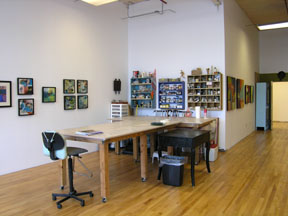
It's not easy keeping the different mediums I use and the projects that I'm working on separated. My studio looks like a war zone right now. Luckily, the paper pieces fit into a flat file and can stay out of the line of fire until called into the commercial battle. Let's hope somebody, somewhere is still buying art.

Sunday, April 5, 2009

HEAT STROKE at the Saco Museum

The New England Wax show at the Saco Museum, HEAT STROKE: New England Wax Artists Working in Encaustic, opened on Thursday night, April 2nd. This show was a real labor of love by the staff at the museum and by N.E.W. volunteers, especially Diane Bowie Zaitlin and Jeanne O'Toole Hayman. Diane and Jeanne deserve a real round of applause for organizing this show and doing the literal legwork up and down all those stairs at the museum. Many other members assisted as well to make it a great show.


Our entries were juried by Katherine French, Director of the Danforth Museum in Framingham, MA. She did a wonderful job of selecting work and made a point of speaking individually with each artist at the opening.


Katherine French awarded three prizes for excellence: First Prize - Kim Bernard of North Berwick, ME (her plywood, encaustic and lead sculpture is in the center of the photo above), Second Prize - Deborah Kruger of Amherst, MA (her textile and encaustic work is on the wall at right in the photo above). (Other work in this photo is by Diane Langley (3-panel green/black piece), Jeanne Griffin and Pat Gerkin.)


Third Prize went to Greg Wright of Lowell, MA.

There were 25 N.E.W. artists in the show and more than 70 works. Here are some of the works in HEAT STROKE along with artists and viewers at the opening, as photographed by Debra Claffey, who very kindly provided the images for this post. All of the work in the show was primarily encaustic.

Saco Museum Director, Jessica Skwire Routhier, addressing opening goers. Work on the wall: three pieces by Kim Bernard and two by Kellie Weeks.

Three artists with work in the show: Diane Langley, Pat Gerkin and Laura Dunn. The multiple-panel work in the background is by Pat.


Work by Diane Langley left and two pieces by Lynette Haggard right.


A viewer studying one of my pieces in the show. To the right of it is Pat Gerkin's piece and then two more of mine. In the foreground is part of a piece by Laura Dunn.


Kellie Weeks with two of her pieces.


Tools and materials of encaustic were displayed as part of the educational aspect of the show.


There will also be artist talks, a panel discussion and a demonstration of encaustic painting.


The opening was well attended by more than 170 people.


And the refreshments were plentiful. (Work on the wall: 3 by Kim Bernard, 2 by Kellie Weeks, 3 by Louise Lamontagne and 1 by Jeanne Borosky (a closeup photo to folow) and 3 works by Laura Dunn - 2 sculptures and 1 wall piece - sorry no closeup of these.)


Bottom left Octopus by Jeanne Borofsky along with three works by Louise Lamontagne.


Girls and Skybabies by Binnie Birstein.


An encaustic collage by Diane Bowie Zaitlin, one of the show organizers.


And a work by Jeanne O'Toole Hayman, the other organizer.


Free-standing works by Julie Shaw Lutts.


Two assemblage/collage works by Sue Katz.


Three pieces by Catherine Weber.


From left, two pieces by Debra Claffey, three by Kim Bernard and two by Kimberly Curry.

I apologize to those in the show whose work was not included in this post.

The exhibition will continue until May 30th.

Wednesday, April 1, 2009

Who Was That Woman?

As you may recall, I've been reading that interminable book on Rothko, and after several years (slight exaggeration), I'm about half way through. You'll be glad to know that he's finally breaking through to his signature style, and he's nearly the Rothko that we who live in the future know.

Anyway, I came to the part where the AbEx group that Rothko belonged to sent a letter of protest about the overly-conservative jury appointed to select work for the Metropolitan Museum in 1950. They protested that the jury was biased against the "advanced art" (namely Abstract Expressionism) then being made in New York that should be made part of the Museum's collection.

That letter actually prompted a front-page story in the NY Times (can you imagine that happening today?) and inspired a story in Life Magazine in January 1951 that termed the group "The Irascibles." Life included what became an iconic photo of 15 of the AbExers.


L to R: Theodoros Stamos, Jimmy Ernst, Barnett Newman, James Brooks, Mark Rothko, Richard Pousette-Dart, William Baziotes, Jackson Pollock, Clyfford Still, Rotert Motherwell, Bradley Walker Tomlin, Willem de Kooning, Adolph Gottlied, Ad Reinhardt, Hedda Sterne. Photo by Nina Leen in Life Magazine, January 15, 1951.

So I was thinking that I would do a post about two women gallerists who promoted Rothko - Peggy Guggenheim and Betty Parsons. As far as I can tell from reading the Rothko book and several others, Peggy and Betty were responsible for establishing Abstract Expressionism and launching the careers of many important artists. While Peggy Guggenheim's New York gallery, Art of This Century, originally specialized in Surrealism and was oriented mainly toward European artists, it also introduced and continued to show work by Rothko, Pollock, Cornell, Newman, Gotlieb and many others beginning in 1942. Peggy had first had a gallery in London (Guggenheim Jeune), but was forced by the war to close it and move back to the U.S. After the war, Peggy closed her New York gallery and returned to Europe in 1947, finally settling in Venice.

Betty Parsons was an artist herself and not trained as a gallerist. She took over most of the American artists who had been with Peggy and established a gallery that eventually became very sucessful, operating until her death in 1982. Helen Frankenthaler said of her, "Betty and her gallery helped construct the center of the art world. She was one of the last of her breed."

I may still write more about Peggy and Betty, who so vitally served this 99.9% male group of Abstract Expressionist painters, but meanwhile, I became interested in Hedda Sterne, the lone woman in the Irascibles portrait, who stands so prominently above the men seated below her.

Hedda Sterne was born Hedwig Lindenberg in 1910 in Bucharest, Romania to a non-religious Jewish family. She escaped the Nazi onrush by way of Portugal and arrived in the U.S. in 1941, where her first husband, childhood friend and fellow Romanian, Frederick Sterne, had already established himself.

Saul Steinberg and Hedda Sterne, photo by George Platt Lynes, c. 1944-45.

Her second husband, whom she married in 1944, was Saul Steinberg, artist and illustrator, made famous by his New Yorker magazine covers.


Iconic New Yorker cover from March 1976 by Saul Steinberg, "View of the World from 9th Avenue"

Hedda's appearance in the Irascibles photo had nothing to do with Saul Steinberg or anyone else but herself. She was an artist who had shown with the Abstract Expressionists and signed the letter of protest, but she refused to categorize her work as Abstract Expressionism. She "grew up with Surrealism" thanks to an artist friend and studied art in Vienna, Bucharest and Paris. She exhibited collages in the "Surindependents" exhibition of 1938 in Paris, where Jean Arp saw her work and arranged to have one of her collages sent to the Guggenheim Jeune gallery in London.

Throughout her life she experimented with various subjects, mediums and techniques, sometimes prompted by observation and other times by ideas, but "at all times I have been moved...by the music of the way things are...And through all this pervades my feeling that I am only one small speck (hardly an atom) in the uninterrupted flux of the world around me." (This quote is from a wonderful article and interview by Joan Simon in Art in America from February 2007 when Sterne was age 96 .) "Uninterrupted Flux" provided the title of a traveling show and catalogue that organized her varied career and work into thematic and chronological groupings.


"Further I", 1984, acrylic and crayon on canvas, 72" x 52." (This image is from a 2007 article in The Brooklyn Rail.)

Sterne said that she had originally been interested in architecture but that she was bad at math so she studied art instead.


"Machine 5" from 1950. "I had a feeling that machines are unconscious self-portraits of people's psyches: the grasping, the wanting, the aggression that's in a machine. That's why I was interested to paint them. And I called them "anthropographs"--maybe it was pretentious thinking [laughs]." (from the Joan Simon interview in Art in America)

Sterne went her own way throughout her career: "I took it for granted that art is essentially an act of freedom. You react to the world totally freely. I met many artists in New York who believed progress is linear, from figure to abstract. In my work I never followed that idea." (from the Joan Simon interview)


Untitled, 1968

Photos of work by Sterne are difficult to find on the internet. Although she drew and painted portraits throughout her life, I could not find any to show here, but just from these three images, you can see how varied her work is. And yet, she is known not for her work but for her appearance in that Irascibles photo, which must have been very annoying.

From everything that I could find, Hedda Sterne is still alive. She would now be aged 99. During the interview that Joan Simon did with her in 2006 when Sterne was 96, she referred to her macular degeneration that began in 1997 causing her to stop painting and the stroke she suffered in 2004 that ended her drawing. She was then mostly blind and able to read for only 15 or 20 minutes at a time with a machine.

Joan Simon asked Sterne how she spent her days, and her reply was so evocative and especially meaningful to me because of my mother's age and infirmity. It gave me greater insight into the feelings of someone who is so old but still has her mental capacity and ability to express herself:

"Now that I am so old and incapacitated, I don't do anything with great enthusiasm. You know, thinking, dreaming, musing become essential occupations. I am watching my life. As if I'm not quite in it, I watch it from the outside. Because after so many years of working unceasingly, and enthusiastically, being idle is a tremendous effort of concentration and adjustment.

The luck is that there is less energy. That's a compensation. It makes it easier. Just sitting. I saw peasants in Romania, you know, on Sunday, when they get up all summer at 4 and work incessantly until noon, let's say. And Sunday they just sit, and their resting is so active - like an activity, resting. It's a beauty to behold, you know. It's not just doing nothing. It's being and existing in a certain way. In a way old age is a little bit like that. It has its beauties."

Sunday, March 29, 2009

Thinking Art Outside the Studio

On Saturday I went up to Saco, Maine to deliver work for the show that New England Wax is having there (Heat Stroke, April 3 to May 30). My friend, Sue Katz, was kind enough to drive us, work by the two of us and by fellow Western Mass. Waxer, Deborah Kruger, in her spacious vehicle, which barely fit all the work we brought. The drive was 160+ miles or 3 1/4 hours each way from Amherst, so it was a long day. I left home at 7:30 a.m. and didn't return until after 7 p.m.

The best part of the day for me was the loooong chat about art that Sue and I had coming and going plus the talk at lunch with a few friends from New England Wax.


Left to right: Lynette Haggard, Kim Bernard, Sue Katz, Kellie Weeks, Greg Wright. (A shout out to Kellie and Greg - diligent Art in the Studio readers!)


One of Greg's paintings was chosen to be the predominant image of three on the show card and then selected to appear on the show poster and flag outside the museum. (Greg Wright: Congregation IV, 2007, encaustic on panel, 14"x14".) This work is typical of Greg's intricate and engaging style of painting, and at lunch we discussed where these forms came from (see below).


Children's Art Show at Saco Museum

Before I get into discussing some of our art conversations and ideas, I just want to mention how impressive the show of children's art was that the Saco Museum had mounted. It was a collaborative installation by area art teachers and a mind-boggling experience to step into the very large back room of the Museum that was just covered with colorful pieces. This was work by Saco-Dayton K-8 students in conjunction with National Youth Art Month.


These photoes only show two sides of the room and don't convey the overwhelming power of multiples demonstrating the various techniques being taught in the schools. I wish I had had time to examine the work more closely.


Were these self portraits? Sometimes I also vizualize myself with a blue nose.


My favorite exercises in this show were the half-and-half portraits (I'm sure there's a more technical art teacher name for this) where the student cuts in half a black and white portrait of someone and then paints the other half of the face. This is such an intriguing idea.
I don't usually look at children's art, not having any little ones of my own, but this was a lot of fun. I hope these art programs don't get cut so that these kids can continue to be excited about creating things.


Art Conversations and the Finer Things
Of course it's impossible to recap 12 hours' worth of art talk, but some of the things discussed included the talk Sue is preparing for the encaustic conference, called "What’s the Big Idea? Discussing Meaning in Our Own Art." Sue will deliver a PowerPoint presentation and then lead a discussion on ideas and processes that generate and propel works. She has been researching for the presentation by interviewing artists about their work and by reading various critics, writers and artists. The discussion of how we make art and what we think about before, during and after art-making continued for some hours and ranged widely.

It continued into lunch, where we talked about why this topic is especially important to artists who paint with encaustic, and here are some reasons why: our medium is new and becoming widely popularized, the technical aspects can be difficult to master and sometimes techniques alone drive works, the medium is popularly misunderstood and misused and, just like any medium, it is used to carry out the intentions of the artist whether the artist formally acknowledges those intentions or not. Sue's talk is intended to address those intentions and get artists to develop and focus on them.

Kim, who is currently in grad school, spoke about how much ideas drive the discussions and critiques of her fellow students and inspire their creation of art. She said that such focus was having a great affect on her own work and causing it to change. A radical change in approach is difficult for artists who have gallery representation, where artists are expected to stick to one consistent look, but we all thought that in the current market, where art sales and representation are so badly affected, there was more room for experimentation and change of style. After all, if nothing is selling, artists can do what they like because sales are not driving their work. We saw this as a good thing in the long run although difficult in the near term.

Then the talk ranged to what inspired us and/or what got us started making art. Some examples: Greg worked as a hair stylist for years. and if you know that, you realize those intricate forms in his work may be related to hair as much as landscape, light or water; Kim's work is inspired by movement and body work and going even more in that direction; I began painting pretty late in life because of the blue shadows I saw on snow and the color I just had to capture; a lot of Sue's work relates to squares doubled into rectangles, as inspired by tatami mats. Kellie told us that her work was full of stories and inspired by them. Lynette said that she was going to take some time in her studio to develop more focus on her work and see what evolved.

Our conversations were fun and inspiring and created bonds of understanding and empathy among us. What's better than a group of artists getting together and talking about art? Not much in my opinion. It's one of the finer things in life.

Thursday, March 26, 2009

Round Up

Past Reclaimed

I was rummaging around in the studio yesterday and came across a little box inside a box that I had packed when I moved my studio back in 2006. My old studio in Ashfield was way out in the country and over-run with mice, so when I packed up a box, I sealed it and got it the hell out of there before Mickey and Minnie could get in it and leave all their turdy calling cards. Anyway, the little box within a box that I found contained artist postcards I had collected over a period of time and a few small mementos that I kept around the studio. One of those things was a framed card I had received from my dear friend and drinking buddy, Ellie, now long dead.

This card meant a lot to me because this is what my mother should have said instead of a lot of other instructions she gave me, such as, "Sit like a lady," "Don't use that F word", etc. So I was glad to find the card - although I did not realize I was missing it.

Progress Report

I'm still plugging along on that Rothko book. It feels like a life sentence, and only now is it starting to get a little interesting, about page 195 or so, where New York has taken over from Europe after WWII and started to be an art center and all the museums are being established. Rothko still hasn't started making the abstractions he became renowned for, but he's getting there. This author analyzes and describes in agonizing detail nearly every painting Rothko made in his Expressionist and Surrealist phases. Man, I hope nobody ever does that to my work. Reading those descriptions is usually when I nod off. How soporific!

Cable Ready

Yesterday we had an outage of the Verizon internet system, and that finally prompted me to make the switch to cable internet. I'm not so sure that it's all that much faster - although it's supposed to be - but at least it will work after a power outage without me having to reset it as I did with Verizon.

But, the good news is that I went for the expanded cable television. OK, I admit it, I'm a TV junkie. Just set me down in front of that box and I'm hooked. We've been struggling along with basic cable since shortly after we arrived, and we only had 10 or 12 channels. And of those, about five were worthless, so it's basically been the three networks, two public TV channels and the local access that airs Gay USA News when it remembers to turn on the feed on Friday nights. Now we're back again with all those expanded choices so we can see:

Ina Garten, the Barefoot Contessa, on Food Network


Rachel Maddow on MSNBC (but with glasses, hair and makeup)


Cesar Millan (left) and Daddy (right) on National Geographic


And, of course, Jon Stewart, on Comedy Central.


Wow, how have I stood it this long? Don't look for much art coming out of the studio. You'll find me, feet up, munching bon-bons on the couch, and eyes glued.

Wednesday, March 25, 2009

Valley of Indecision

Sorry I've been MIA for a few days. Life got in the way.

But I've been in the studio working a bit. And here's a new diptych that I'm calling "Masquerade." It's encaustic with roots and beads on two panels - each panel 16"x16"x1.5". These are panels that I made myself. I think I should reshoot the photo because the panels look distorted. They really are square - honest!


My friend Sue told me that I should try for more color subtlety but that's a lost cause. These colors are subtle enough for me although I did have trouble with them because of the warm palette. I'm much more comfortable with cool colors.

So here's my problem: I made another diptych in orange, etc. that I really wasn't happy with. It's probably too much information, but here are three versions:

Version 1 - encaustic with roots, toothpicks and leaves. I didn't really think that the two panels had enough connection except for the color, so I made...


Version 2 - in which I turned the first panel on its side and extended the lines. But I thought this made it look too much like balloons or boobs, so then I...


Version 3 - turned the panels around. But then I thought it was kind of boring and not really like my work.

So, reader, I scraped.

That's the wonderful thing about encaustic - just heat it up and scrape away. All your indecisions, bad decisions, and misdirections just end up in balls of wax and you start over with nice, clean panels.


My Bowl of Balls in the display window at my last show.
I'll let you know how things turn out with Version 4.