Tuesday, February 9, 2010

Attacking the Studio

Perhaps "attack" is the wrong word when beginning a project like this. I guess it's more like "avoid" and then begrudgingly begin.

Part of the avoidance was a back issue of Art in America that I received yesterday from Linda Cordner at the New England Wax meeting. She was kind enough to think of me when going through some old issues and seeing an article on El Anatsui.


This was a great issue of the magazine and I was very glad to page through it while eating my lunch. (Always eat as a means of avoidance is my motto.)


May 2006 issue of Art in America


There were a couple of El Anatsui pieces that I had not seen before, and I liked the way they were photographed because you could really see the texture of the aluminum bottle caps and wrappings that the pieces are made of.


This spiral piece is really fabulous looking and seems very different from his other work. It has so much dimension and the spiral seems set into the background of vertical strips. All that gold reminds me of Egyptian jewelry. It is a great piece.

So I read the article and then continued to page through. There are many other interesting articles in this issue and I am keeping it next to my chair so I can read them during future avoidance sessions.


One of the things I found in the magazine was this very amusing list by Amy Sillman. On the left are remarks that people make to artists at their openings and on the right is what they are really thinking. If you click on the image, it will open larger so you can read it more easily.

Well, by this time a couple of hours had passed and I was starting to get anxious thinking about all the work I had to do. What's happening is that I am teaching a class of Smith College students about encaustic next week at my studio. On Tuesday I will demonstrate encaustic painting and present a Power Point about the history of encaustic (with a survey of contemporary work in encaustic). Then on Thursday, the students will come back and experiment with the medium themselves. This is a class called "Historic Methods and Materials," and I believe that this is the first time the class has included encaustic in addition to oil painting, fresco, etc.


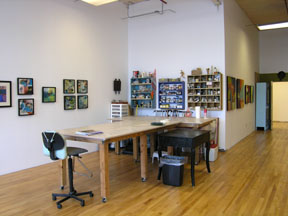
So this is what I'm contending with - a studio packed with stuff in various piles.


Messy working habits with half-completed projects strewn all over.


And barely room for me to walk around in let alone let students into.


Paint and materials for the Smith class


But worse than anything is this corner of my storage area that is (was) piled with bags of old bubble wrap, cardboard boxes and scraps of painted papers from years ago.

I'm happy to say that once I put down the magazine and got going, I tackled the bad corner first and took two shopping carts full of cardboard and old wrappings down to the trash room. I already have the cart filled and ready again with the next load. It's a relief to get at this mess and dig it out. Why did I save it all? is what I kept asking myself as I unearthed yet another bag full of bubble wrap scraps. And the answer, I guess, is because "you never know when it might come in handy." How much crap has been stored under that rubric and how good it feels to say, "I don't care."

Thursday, February 4, 2010

Another Fave Showing in NY

El Anatsui at Jack Shainman Gallery, New York
February 11 to March 13


El Anatsui, "Intermittent Signals", 2009, found aluminum and copper wire, 11 feet x 35 feet
(All images in this post courtesy of the Jack Shainman Gallery website)

El Anatsui is a native of Ghana, head of the sculpture department at the University of Nigeria-Nsukka (UNN), where he has taught since 1975. He was born in 1944, has influenced many young artists in Nigeria and West Africa and has become very successful with his metal cloth works made from pieces of found aluminum wired together with copper wire. 


I was wowed by his work the first time I saw it online and have posted a couple of times in this blog about him (for instance, here and here).  I also did a longer post here about the origins of el Anatsui's work and how it relates to Adinkra and Kente cloth. With all of this, I have never seen his work in person, and I'm so looking forward to it seeing it at the show that opens next week. The gallery also has a large catalog of el Anatsui's work available (see their website) and I'm gonna get me one.


"Three Continents", 2009, found aluminum and copper wire, 8 feet x 16 feet


What appeals to me so much about his work is first of all its beauty and golden mosaic-like quality, but also the fact that it's made from found and recycled material, that it has a very physical presence, that it resides somewhere between flat painting and volumetric sculpture and that el Anatsui has very definite meanings and emotional associations motivating his work.  The huge size of the works are also enveloping (I imagine), and, ever practical as I am, I really like that they probably fold up and take relatively little space to ship and store.


"Fading Scroll", 2007, found aluminum and copper wire, 8 feet x 39 feet


"Fading Scroll" detail


What I didn't mention above is the "textileness" of the work; that is, his pieces are like giant, metallic pieces of cloth. Textiles play such a large part in the African heritage (indeed in human heritage) that we are often unaware of the important place they hold in every culture. They are so ubiquitous that we don't see them for what they mean or symbolize.


An example of the more muted-color kente cloth woven in Ghana by the Ewe people, which is el Anatasui's heritage


In regard to Africa, Kente cloth has come to represent Africa and African heritage. El Anatsui's father and brothers wove kente cloth in his native Ghana, and he has said about his own work: "I have discovered only much later...that cloth has been a recurring theme or leitmotif, and it is featured in so many dimensions." The specifically African textiles of Adinkra and Kente "communicate cultural and philosophical meanings, social codes of conduct, religious beliefs, political thought and aesthetic principles."  (quoting from the Fowler Museum, UCLA, website about "GAWU", el Anatsui's show.)


Untitled, 2007, aluminum and copper wire, 144" x 192" (the first one I've seen with so much black in it - my favorite color)


Besides this deep foundation in textiles, the meaning in el Anatsui's work also derives from the materials he uses - aluminum labels and wrappings from the local Nigerian brands of whiskey, rum, vodka, brandy and other liquors. He says his works "encapsulate the essence of the alcoholic drinks which were brought to Africa by Europeans as trade items at the time of the earliest contact between the two peoples." The brand names of the Nigerian liquors have their own connotations, for example, Chairman, Dark Sailor, King Solomon, 007, Top Squad, etc.


"Bleeding Takari II, 2007, aluminum and copper wire, about 13 x 19 feet
(I tried to find out what this referenced and learned that the Takari are/were northern Nigerian immigrants in northern Sudan, but I could not discover what social or political events el Anatsui really referred to with the bleeding.)


This piece was just called "Installation View 2007" at the Palazzo Fortuny, Venice, Italy, and I assume it was installed at the 2007 Biennale. This speaks to me so much of Africa - huge, beautiful and full of of holes where the fabric is unraveling because of war, famine, AIDS, poverty, political unrest and deliberate disregard by the rest of the world.

Monday, February 1, 2010

Two Favorite Artists in NY at Once!

I can't believe my luck that just when I decided that I owed it to myself to make a trip to New York to look at some art, who should appear but my two favorites - Leonardo Drew and El Anatsui - both exhibitions up at the end of February when I plan to go. What are the chances of that? So I'm going to post about each of them in case you do not know their work and to get myself even more jazzed up. (It's unlikely that you don't know about el Anatsui, but anyway.)

Leonardo Drew
at Sikkema Jenkins & Co., January 30-March 6


Image from the Sikkema Jenkins website

I first became aware of Leonardo Drew's work when Gwen Plunkett posted images on her blog from his big show last summer at the Blaffer Gallery at the University of Houston, called Existed: Leonardo Drew. It was his first mid-career survey in the U.S. and had 14 major sculptures made between 1991 and 2005, plus a new installation made just for the gallery and 12 works on paper. It looked fabulous. There were also three videos (now down to two) on the gallery website and I'm including one below where he talks about the meaning of his work: birth - life - death = regeneration.

I bought the catalog from the show (also called Existed: Leonardo Drew) from Amazon (here's the link) and it was just fabulous. 


So here are more images of Drew's work (taken from his website). 


Number 31A, 1999, wood and paper, 120 x 172 x 8 inches


Detail of Number 31A


Number 43, 1995, fabric, wood, rust, 132 x 444 x 5 inches


Detail of Number 43


Number 75, 2000, rust, wood, miscellaneous objects, 144 x 144 x 4 inches


Detail of Number 75


In regard to regeneration, Drew believes in regenerating work from other work so he may combine pieces, such as he did with Number 75. It became part of Number 77, as follows.


Number 77, 2000, rust, wood, miscellaneous objects, 204 x 672 x 4 i nches (that's 17 x 56 feet). That's a lot of miscellany.

I hope you find Leonardo Drew's work as exciting and evocative as I do. There is such meaning in cast-off, decaying things - all the stuff of our lives that is so important until it isn't anymore. Then it becomes just so much detritus, evidence of lives lived and time passed. The objects take on a significance of their own and their decay reminds us of our own decay and mortality. Time adds a patina of rust, grime and weather. It's heavy but beautiful, what Drew refers to as "emotional weight."

Wednesday, January 27, 2010

New Work and A Follow Up

Last week, in a flush of inspiration and do-no-wrongism, I finished these two pieces within a half hour. OK, it might have been longer if I allow for fiddling time. But anyway, it was damn quick after these pieces had been kicking around the studio for a while and refusing to cooperate with me.


"In Transition", encaustic and mixed media on panel, 16" x 16", 2010


"Lying Beneath", encaustic and mixed media on panel, 16" x 16", 2010


So I sent images of them off  today to the Lake Oswego Art Show in Oregon that is happening next June. That is a big encaustic show that many members of IEA (International Encaustic Artists) are working on. Somehow they forgot to actually invite me, so the only way I can get in is to be juried in. It would be nice to be in the show because I have some relatives out there that might go to see it as they live nearby.

Along with the two pieces above, I added a diptych that I completed last year. I thought it rounded out the trio.


"Prologue", encaustic and mixed media on two 16" x 16" panels, 2009


A plethora of panels
Yes, it's true that I thought it would be a good idea to make my own painting panels, and I still do, but it turns out that I am a lousy carpenter. My table saw is too feeble for ripping (cutting lengthwise) in a sustained way and I am too unskilled or impatient or something to cut the cradle pieces so that they actually meet up or match up with the plywood on top. So I ordered a big batch of panels in different sizes and brought them up to my studio today. It's so enriching (I mean that I feel rich) to see them stacked there all ready to go, not needing cutting, gluing, sanding, etc, etc. What a relief! So it did cost me, but it was worth it. And to celebrate, I went ahead and started a piece on one of them as soon as I had unloaded everything. It was a pleasure.


No, no, Nanette
If you are a regular reader, perhaps you will remember back in November when I posted the three images of oil paintings that I had submitted to my alma mater, Mass. College of Art, for their auction. The auction is juried and you can submit three images for them to choose from. You blogees seemed to like them and selected your favorite, but unfortunately I learned tonight that the auction jury committee did not agree with you, and they rejected all three. It's never a good feeling to have your work be rejected - even if it's something that you are donating - because it feels like you personally are being rejected. In this case, I had actually thought that I would like to keep these three pieces because I liked two of them and one I wanted to repaint. So it really doesn't matter - except that it does.


These are the two I like.  The first one needs repainting. I hung it in my livingroom and I've been staring at it for months. It's always something.     


Sunday, January 24, 2010

Bits and Pieces

No, I'm not still sulking over Martha's loss to the pickup-driving nude model. And neither am I over-bemoaning the opportunity for corporations to assume control over even more of our non-corporate world now that their purse strings can be totally untied to elect whoever or pass whatever serves their beastly interests. Nope. Not me. I'm keeping my mouth shut.


(These are not my lips. Matter of fact, they look kinda like Martha's lips.)

While not talking, I've been spending my time getting my computer cleaned of viruses that I picked up this morning when I was searching online for articles about the history of encaustic. I spent about four hours tonight chatting with the McAfee wiz in India who used Ice Sword software to cut out 9 pop-ups and 2 trojans that invaded my computer in less than two minutes this morning. BEWARE of these pop-ups that claim to be anti-virus software and scream at you that your computer is under attack. (Yes, it is under attack from you, you rotten bastard!) I knew it was fake because I already have McAfee installed and I went right there to stop the nonsense. The question is, why didn't McAfee see these things before I did?


Anyway, for a mere $89.95 and four hours of my time, I was able to watch while Unnikrishnan from McAfee took over my screen and cleaned out all the garbage those things put into my beautiful new computer in the mere two minutes before they were quarantined. If I hadn't caught them when I did and got McAfee to quarantine them, they would have proliferated throughout the whole hard drive. Scary and the first time it's happened to me. So be on the alert about this - but I guess it goes on all the time, just never before to me.

Today was a pretty good day in the studio although I have nothing to post here. I finished my 24"x24" piece for the New England Wax Exquisite Corpse project. This should be something to see when it all comes together. If nothing else, it will be really big.

Then I finished two painting that have been kicking around the studio for months. I worked on and abandoned them last summer, but I didn't strip everything down because there were things I liked about parts of them. They hung on my wall all these months until last week when I decided to give them a go again. I could not decide what to do with them last week no matter how I tried and I painted and scraped until I made myself crazy. Today I just picked up a brush and finished them both within half an hour. Crazy! I'll post pictures next week.


Just for something fun to look at - not mine, obviously, but Matisse's Red Studio.

After that success, I decided to tackle another project that I've had in mind for some time - to build a piece in a drawer taken from one of my mother's end tables. I had already worked on strengthening the drawer to get it ready, but what I had in mind turned into the worst kind of amateurish craft project when I tried to make it happen. Nope. Not gonna work. But not to worry, I have another idea to use the aged book covers that are inspiring this effort. There's always another way and maybe Plan B will work out better.

Wednesday, January 20, 2010

R.I.P.


Monday, January 18, 2010

How to Work With Paper

Encaustic painted on paper instead of wooden panels is another of the New England Wax projects we are currently undertaking. (I seem to have signed up for nearly everything - silly me.) This project has some restrictions (which I am choosing to view as guidelines) and it has a theme. The paper is supposed to be 300 lb watercolor paper, the size is 10" x 10", we are supposed to do four pieces and the theme is "Cycles." (The other theme proposed was Bugs. I liked that much better.)

I started right off by deciding to work very differently from the way I usually do and have some fun with ink on the paper.


Between Sea and Sky #1

Confession No. 1: I did not use 300 lb watercolor paper.
I used what I had, which I think was Rives BFK print paper, and I don't know what the weight was. First I cut some paper into 10" x 10" squares and then I messed around with brushes and pens and had a fine time. Then I cut up a bunch of old book pages and stuck them down with encaustic. Then I tore up a bunch of painted paper and stuck it down with encaustic. Then I painted over the ink with encaustic. Then I saw what I had and it was... not good.


Between Sea and Sky #2


Confession No. 2: I had no idea what I was cycling.
Well, I thought, if the whole is not good, maybe it will be good in parts. So I got out my knife and started cutting those 10" x 10" squares into strips. It was fun to arrange them in different sequences and maybe go back to the encaustic and paint a bit and maybe go back to the ink and paint a bit and move them around more.


Between Sea and Sky #3

Confession No. 3: I glued everything down on another piece of paper.
So I had all those strips and had to join them together somehow. First I thought of sewing them together, then I was going to overlay them with a thin piece of paper or cheesecloth. Then I thought of glue. Back to the cutting board I went to make more pieces of BFK, this time 11" x 11" so I could assemble the strips into the required 10" x 10" squares and have some room to overlap and let the glue seep out at the edge.

After I had glued down the four panels (a total of 20 strips), I weighted them down with the several copies of Jansen's History of Art that I keep for that purpose. The panels were mostly flat. I did have several strips that were pretty thick next to some that were pretty thin and this caused some problems, but I weighted them down again and left them overnight.


Between Sea and Sky #4

The next day, I removed the Jansen's and began filling in a few cracks between strips with encaustic. Then came my biggest and most tasking task - discovering the direction in which the panels should be shown and which sequence; I just had to find that Cycle.

I know you will concur that I have discovered the perfect sequence for these panels. I am calling it #1, #2, #3 and #4. Since they contain a lot of blue and white, I am calling them "Between Sea and Sky" and this is a perfect name for all the cycling.