Making art in the studio, listening to music or NPR and thinking, all the time thinking. It could be about red versus orange or politics or the world collapsing around us or growing old or (most probably) wondering what to have for dinner.
Showing posts with label the encaustic conference. Show all posts
Showing posts with label the encaustic conference. Show all posts
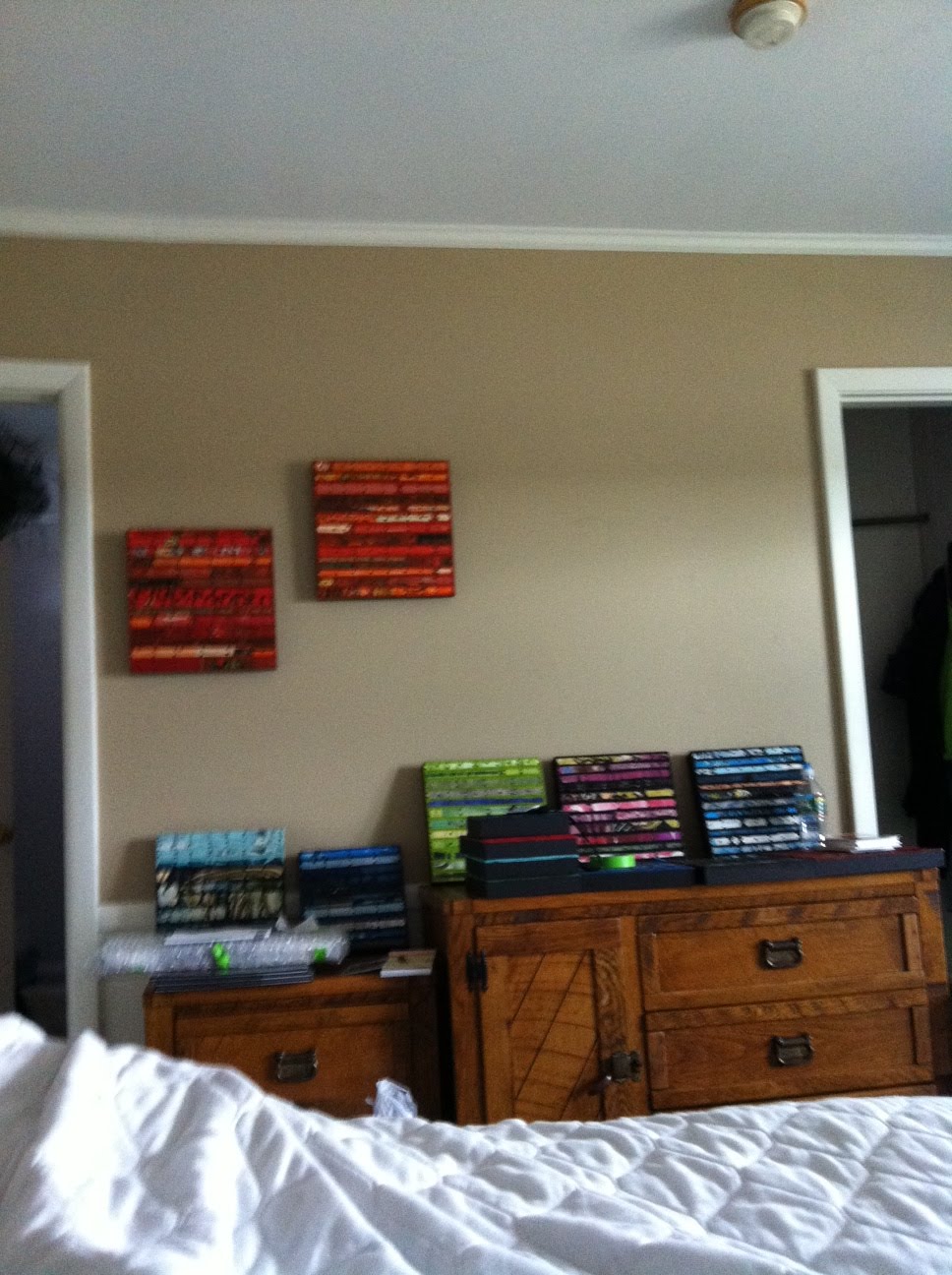
View from the bed of the hotel fair remnants - that bump in the
bed is my feet.
(This post was written Sunday afternoon when I crashed for an hour or so. It was all too much! But I didn't have internet in my room and couldn't publish it. So just think that you've gained a couple of days and it's really still Sunday. Don't forget to watch 60 Minutes tonight or some crazy reality/entertainment show.)
I'm lying in bed resting and just thinking that I didn't take a single photo of my hotel room show this morning. This photo is one wall of the pieces that remain. Thanks so much to any readers who purchased a piece or traded with me. It was wonderful to experience so many people coming by and saying complimentary things.
Binnie and I were up before 6:00 this morning (Sunday) to get our showers in and get dressed before starting to move furniture around and hanging our work. We were already exhausted from the pace at the Sixth International Encaustic Conference, but we rose to the occasion and presented ourselves this morning as well as visiting other rooms to see what people were showing. Unfortunately, it was much too much to pack into a short period of time and I apologize to those whose rooms I didn't get to visit.
We could have a conference of just the hotel fair - but think how much we would miss. The work was great, the networking fascinating and the opportunity to see the face of the artist with the work was exceptional. It was wonderful and each year it gets better. We do have to ask Joanne to work on the virtual time aspects so that we can all be in two places at once -- both presenting our work and viewing everyone else's. I'm sure if anyone can master it, she can.
Provincetown with the monument at its back. It's the first thing you'll see as you drive up or arrive by ferry.
As if I needed to add to my anticipation of going to Provincetown (Ptown) for a week for the encaustic conference and post-con workshops, the other day I read Land's End: A Walk in Provincetown by Michael Cunningham, as recommended by Joanne Mattera on the encaustic conference blog. Although I'd read a couple of other books about Provincetown, I had never read this one. It's a wonderful, lyrical and funny book that captures the spirit and character of that odd place at the end of the Cape Cod hook. Joanne is right: read it before you go and then read it again after you've been there.
Author Michael Cunningham
The book cover with a painting by Provincetown artist and Cunningham friend, John Dowd
My Ptown History
I am no expert on Ptown by any means, but Cunningham's book really resonated with me. I spent one summer there the year after Bonnie and I got together (nearly 26 years ago). Other than that, it's been just a few days or a week from time to time. For a few years I was a member of the Provincetown Art Association & Museum (PAAM) so that I could participate in the annual members show. I won first place in that show in 1996 and the next year I had a solo show at the Art Association in the Ross Moffett Gallery as the prize.
"Learned to Laugh," 1997, about 30"x40", collaged xerographic prints in a found frame with dental x-rays. This was the image on the card for my show, which was called "Rest Area."
The old PAAM, first established in 1914, this building was purchased in 1919
The new PAAM (note the old building to the right of the picture). This addition/remodel was built in 2005/06.
Ptown Art History
Anyway, I was thinking that it might be fun to post some images of artists and artworks from Ptown's past for general interest and to give some context for people attending the conference who might not know about Provincetown. So where to begin?
The Three "H"s
Although there have been multitudes of artists who lived, painted, wrote, acted, danced, sang, and performed all manner of artistic activities in Provincetown, in terms of visual art (painting to be more specific), there were three men whose names began with the letter H who were major players: Hawthorne, Hensche and Hofmann. They were teachers who influenced generations of artists in and outside of Provincetown.
Charles Webster Hawthorne demonstrating painting en plein air, ca 1910, on a pier in Provincetown
Hawthorne about 1910
Charles Webster Hawthorne (1872-1930) studied with William Merritt Chase, known as the leading proponent of American Impressionism. Hawthorne established the Cape Cod School of Art in Provincetown in 1899. It was the first outdoor school for figure painting and became one of the leading art schools in the U.S. Hawthorne was also one of the founders of PAAM in 1914.
Hawthorne painting of an artist en plein air
Hawthorne's painting of Ptown fishermen (I believe this painting is owned by the town and displayed in Town Hall)
By 1916, Provincetown was reputed to be the largest art colony in the world! Hawthorne gave weekly instructional lessons and critiques, and his school attracted well-known artists as well as beginners.
Henry Hensche (1901-1992) the second of the H-men, studied with Hawthorne, became his assistant and ultimately carried the torch of his teaching methods and theories. When Hawthorne died suddenly at age 58 in 1930, his school closed. Five years later Hensche reopened the Cape Cod School of Art and carried forward Hawthorne's work by emphasizing Monet's Impressionist tradition of seeing and painting color with light. Hensche referred to himself as a member of the "color realist movement." Both Hawthorne and Hensche taught their students to paint with putty knives and Hensche also added block studies-- "light key, masses, and variations of masses are the essentials of all visual logic." http://www.tfaoi.com/newsm1/n1m288.htm
Hawthorne portrait of Hensche
Hensche in painting demo
Hensche portrait of woman in hat
Hans Hofman (1880-1966) the third pillar of the Ptown teaching trio took an entirely different approach to painting. Born in Bavaria, Hofmann established himself first in Germany and Paris and then moved to the U.S. because of WWII. He retained his European connections but was accepted as an important force in American painting, for example, being included in the Whitney American painting annuals from 1945 on. Hofmann was a player on the world stage of art and spanned art history from Jules Pascin to Picasso, Braque and Matisse through Ashile Gorky, Clement Greenberg and Harold Rosenberg to William Baziotes, Willem deKooning and Bradley Walker Tomlin. He showed throughout Europe and the U.S., had his first New York show at Peggy Guggenheim's gallery, was one of the Ab-Ex Irascibles, represented the U.S. at the 19560 Venice Bienniale along with Philip Guston, Franz Kline and Theordore Roszac and received honors, accolades and attention from all corners.
Hans Hofmann cleaning his brushes
A teacher of legendary energy and enthusiasm, Hofmann first established an art school in Munich during WWI and then, forced out of Germany by WWII, brought his school to New York in 1933 after having taught for a while at the Art Students League and other venues. His Provincetown school began as a summer venture in 1935 (note that it was the same year that Hensche reopened the Cape Cod School of Art). From 1939 on, Hofmann spent five months a year in Provincetown and the rest of the year in New York, teaching in each location at his own school. He taught until 1958 when he was 78 and wanted to spend more time on his own work. (official Hans Hoffman website)
Hofman landscape, 1941
Hofmann "Sanctum Sanctorum", 1965
Hofmann, "Lonely Journey" 1965
Hofmann's Push Pull Theory of painting emphasized that two-dimensional space could be created using color and shape rather than depicting objects from a one-point perspective. (Here's a fun experiment from PBS where you can play with color to see Hofmann's theory at work. Be sure to click the brush on the color that you want on the palette first and then on the shape on the blank canvas.) This theory was an important influence on the development of modern art.
Pasted below is a short video that shows Hofmann in the classroom with students and features students talking about the man and his methods. I think this is from the PBS special on Hofmann and is narrated by Robert deNiro. (Ignore the way he pronounces Gloucester as Glowster.)
The Two Painting Camps in Provincetown
Although these three painters/teachers were united by the common first letter of their names, the devotion of their followers to their conflicting theories of painting caused a rift that found a locus in Provincetown. The two schools were known as Regulars (Hawthorne/Henshe) and Modernists (Hofmann and others) and between 1927 and 1937 PAAM held separate annual exhibitions of work for each group after 30 Modernists led by Ross Moffett petitioned for a show of their work. In 1937 PAAM held one show--Regulars on one side of the main gallery, Modernists on the other. From then on they tolerated each other and/or buried their differing views.
Today there are still devoted followers of the Hawthorne/Hensche painting tradition. For example, Hilda Neily, who studied with Hensche for 15 years, runs a gallery together with artist Rob Longley, another Hensche student, and teaches the brand of plein air impressionism learned from Hensche.
Hilda Neily, "Early Summer Light"
Hilda Neily, "Monument View"
Robert Longley, "Monument at Night"
On the other side of the divide, the distinction becomes harder to identify and interpret, but here are a few "Modernists" whose work you may see in the Ptown galleries or the PAAM collection or know from other museums.
Paul Resika, "Dark Lady", 2001-02. Resika shows at Berta Walker Gallery
Resika, "Calabash Beach" 2008, gouache on paper
Resika, "Regatta/Three Sails" 2009-10, oil on canvas
Ross Moffett, "Life on the Dunes" (unknown date but looks like the '30s)
You can see more of these and other artists on the Provincetown Artist Registry here.
Another Major Contributor
The Fine Arts Work Center (FAWC) was established in Provincetown in 1968 by a notable group of artists and writers who intended to make a place for young people to develop their work at an early stage of their careers. Cunningham says they wanted "to restock the town with younger artists and writers the way a forest service restocks a lake with fingerling trout." Residencies run from October 1 to May 1 for ten writing fellows and ten artists from all over the world. During their seven-month stay, fellows get a place to live and work and a small stipend. They must remain in Provincetown throughout the period and focus on their work. Many fellows stay on in Provincetown after their residencies and form a core group of artists and writers with an affinity for the place and its history. Michael Cunningham, for example, first came to Provincetown twenty years ago for a residency at FAWC after two years in the Iowa Writers' Program and never having been east of Chicago. He developed a lifelong love of Provincetown although he makes his main home in New York.
Fine Arts Workshop (a place that's very hard to get an image of online for some reason)
This collection of buildings was formerly Days' Lumberyard where many artists rented studios for the summer. An interesting page on iamprovincetown.com gives lots of info about who, when and how much (peanuts) they paid for work spaces.
The old lumber bins were apparently turned into studios for the hardy artists who rented space.
Notable Notables
You can look up these people with a strong Provincetown connection if you have the urge:
Norman Mailer
Jay Crichley
Stanley Kunitz
Pearlene
Meryl Cohn
Tony Vevers
Kate Clinton
Eugene O'Neill
Edna St. Vincent Millay
Ryan Landry
Tennessee Williams
John Waters
Mabel Dodge
Robert Motherwell
Mark Doty
Varla Jean Merman
Robert Pinsky
Edward Hopper, "Cape Cod Afternoon"
More, Much More
I hope this piques your curiosity about this fabulous place at the end of the road. Meanwhile, here are a few more images of works that I admire by Provincetown artists.
Paul Bowen sculpture - wood, tar and found materials
Another Bowen wood+tar work
Anne Packard, "Cape Marsh"
Anne Packard, "Long Point"
Anne Packard, "Waiting for the Tide"
Anne Packard is a beautiful painter. You can click on these and get more of a sense of them. She has a gallery in the gallery district of Commercial Street. Two of her daughters are also painters.
Cynthia Packard, "Jen"
Leslie Packard, "Purple Flowers"
Pat deGroot, "Dark Sea and Dazzle"
Marian Roth, pinhole camera photograph
Polly Burnell (info unknown)
Elspeth Halvorsen, "To the Monument," construction, 2007
Nancy Whorf, "Welcome to Provincetown"
Nancy Whorf, "Shoveling Snow, " 2007
Sal Del Deo, "Low Tide, East End," 1990
Sal Del Deo, "Winter Solstice," 1982
Finally, I'll leave you with an image of the monument the way I began. By the way, if you are looking for something to do in Provincetown and feel the need for a little exercise, climbing to the top of the monument will provide you with that plus a great view from the top. Along the way, you can read the inscriptions on the stones that were purchased by various cities, states, countries, groups and individuals.
One thing that Michael Cunningham mentioned that I hadn't heard before and MUST check out as soon as I arrive, is that the top of the monument bears a distinct resemblance to Donald Duck.
"The Pilgrim Monument is visible almost everywhere, in town and in the wild. If you look at it from the proper angle--obliquely, from any of its four corners--you can see the head of Donald Duck. The top of the tower is his hat, the arches are his eyes, and the crenelations under the arches are his beak. The Donald Duck head is slightly difficult to see, but once you've seen it, you can't look at the Monument and see anything else."
So clean, so neat, so unused (click picture for link to my website) - my URL - http://nancynatale.net, Email: nancynatale@gmail.com
My work is now included on Geoform
This is an online scholarly resource and curatorial project of Julie Karabenick that features works by artists around the world. CLICK THE IMAGE TO SEE THE SITE.
Still available from blurb.com: The Running Stitch Series
Click picture to link to blurb.com
A portfolio of my work is included in this beautiful new book
Encaustic Works 2012: A Biennial Exhibition in Print, organized by Laura Moriarty and designed by Heather K. Aderson, with an essay by juror Joanne Mattera; artwork on cover by Ellen Koment.
Now that I have the search feature on the blog, you can use it to find posts about a particular subject. It works like a charm. Thanks, Google!
Some topics you might like to look up:
El Anatsui
Richard Diebenkorn
Leonardo Drew
Encaustic conference
Encaustic painting
Philip Guston Joan Mitchell
Joanne Mattera
Lee Bontecou
New England Wax
Physical Geography
MarkRothko - 6 posts about him and the bio by Breslin
Hedda Sterne Studio photos
Followers
What am I reading?
I'm always reading something and now it's another one of Robert Caro's volumes of Lyndon Johnson's biography. "Passage of Power" is the fourth volume in this monumental series and covers the years 1958 to 1964. This period of Johnson's life was full of extremes of power - from the peak as Majority Leader of the Senate, then fading as he failed to actively campaign for the presidential nomination in 1960. Once he joined Kennedy on the 1960 Democratic ticket, his southern connections gave Kennedy the win, but Johnson sank into powerless oblivion and became the butt of jokes by "the Harvards." On Kennedy's death, Johnson ascended to the presidency and experienced another series of extremes of political power.
Caro is a master of biography and is always interesting and informative. I recommend this volume (and series) to anyone who follows politics and wants to know some background on how we got where we are today.