Showing posts with label Montserrat Encaustic Conference. Show all posts

Thursday, June 17, 2010

Tuesday at the Conference


On Tuesday I attended Homage to Fayum, an all-day workshop taught by Francisco Benitez at the Fourth Annual Encaustic Conference. This was terrific and Francisco a/k/a Paco is a great teacher.

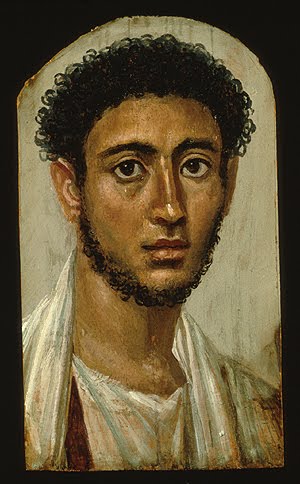
Those Fayum portraits are so compelling that they are admired throughout the world and leave many people wondering how they were made. Paco has spent a lot of time researching them and other ancient works in Greece and Italy, and in this class he explained that the portraits were painted with just four earth (mineral) colors: red ochre, yellow ochre, black (from ash) and white (powdered gypsum or powdered calcium carbonate). Francisco was a visiting artist at R & F and demonstrated the process there. The R & F colors that we used in our workshop were Mars Red, Mars Yellow Light, Mars Black and a mixture of Titanium White and Neutral White.

Above: One of the original portraits found in the Fayum district of Egypt (now in The Metropolitan Museum, NY) 125-50 A.D., encaustic on wood, 14 5/8” x 7 7/8”


Right: A mummy portrait in place on a mummy (This mummy and portrait are dated to 80-100 A.D. from the Fayum district of Egypt. The portrait is encaustic on limewood.) The portraits were painted to depict deceased people. Whether they were done earlier in life when the person was still youthful or made as idealized portrayals after death is unknown.

I'm reviewing this information for you so that you will have the context in mind for the work that Paco has been able to analyze and the process he has recreated.

It has been difficult to discover exactly how the ancients worked because so few tools and no real treatises have been found about it. One of the few finds of artist's tools was made in northern France with the discovery of the tools of a Greek woman artist.

These are ancient spatula-type tools called "cauderia" in Latin. The ancient process was to work vertically and apply the melted wax with a brush or spatula and fuse it by bringing near a cage containing hot coals mounted on the end of a stick. (This so reminds me of Jasper Johns' method of a hot plate on a stick for fusing.)

There are three processes that Paco uses in his contemporary work: a brush in one hand and a heat gun in the other, a heated tool connected to electric power, a non-electric cold tool that can be used alone or with a heat gun or even a hair dryer.

He begins his works by preparing a cradled panel with rabbitskin glue pigmented to a dark greenish black. He lets this dry overnight. and the next day he makes a sketch on the panel with charcoal or conte. He applies a coat of encaustic medium to preserve the sketch and seal in the rabbitskin glue.

The beginning colors are a cool dark, mixed from black and yellow ochre, and a warm dark, mixed from black and red ochre. A sketch is made on the greenish black ground with the warm dark (reddish) so that it is visible.


Francisco Benitez did this sketch of an eye in our workshop. The greenish black in the center is the rabbitskin glue ground. The darkest color is the reddish black mixed with black and red ochre. The red color that will underlay flesh tones is mixed with red and yellow ochres.


Francisco Benitez blending colors and fusing paint with an electric tool.


Working on the sketch with a brush and heat gun.

The process is to work from dark to light. (A procedure known as tenebrism.) All the skin tones are underlaid with a red mixed from red ochre, yellow ochre and black. The whites and light yellows are laid on only at the end of the process as the volume of the figure emerges from darkness. Note that the tools or blending brushes both blend the colors together to give volume in the portrait and at the same time fuse the encaustic with heat.


Hot tools are cast tips that are attached to handles with temperature-controlling regulators. They are the type of tools used for woodburning and only the heads are different. R & F Paint is working with Sculpture House to manufacture the specialized heads, which will be available in August.


Cold tools - Many of these tools are used in sculpture and are currently available from Sculpture House.


This is an unfinished portrait that Paco painted in his demo class earlier in the conference.


Here is a closeup of the portrait showing the modeling and marks made from the heated tools.


This is our model Arielle (I hope I have the spelling correctly.) who sat for us all day long. She was also the sitter for Paco's sketch above.


Here is my portrait completed in the workshop. I haven't painted a portrait in 20 years so my modelling leaves a lot to be desired, but I had a lot of fun mixing color with just the four hues. It's amazing how much variety you can get with such a limited palette. My color does not follow the standard of the Greek painters who used much more yellowish skin tones. I think I'll keep working on this portrait and see if I can push back that Jay Leno chin in my painting.

And just to show the wonderful results that can be achieved by a master of this technique and a beautiful painter, here is one of Francisco Benitez's finished portraits from his website.


Epithimia, encaustic on panel, 24" x 20"

I enjoyed this workshop a lot even though, or maybe because, it was so different from my way of working and the works that I usually produce. Sometimes it's really beneficial to make an extreme redirection to appreciate what you already have.

Post Post-Conference
Julie Shaw Lutts, a conferee (and a member of New England Wax, I might add) graciously invited post-conferees to a barbecue at her home in Salem on Tuesday evening. She has a gorgeous Architectural Digest-type home located on a marsh in the next town over from Beverly.


The setting looking out from Julie's yard.

The food was absolutely delicious and the deserts were to die for. Many of them were intensely chocolate, including the birthday cake that Julie made for Sarah Bartlett, her friend and one of the conferees.


Sitting on the lawn in Julie's yard. (Thea Haubrich in the foreground.) Through the trees in the distance is one of the coves on the waters of the Atlantic Ocean in Salem.

This was quite an end to the conference for me. All the chocolate that I consumed was enough to keep me wide awake for the two-hour drive back home to western Massachusetts, and I barely had to sing to keep my eyes open. I was mighty glad to see my little homestead and to sleep in my own bed last night, but I sure did have fun at the conference.

Tuesday, June 15, 2010

Monday at the Conference


My orb panel - the final product in today's post-conference workshop, Off the Wall: Encaustic in Three Dimensions, with Miles Conrad.


Miles put on his usual wonderful workshop. I really loved playing in wax all day with different materials and seeing the unexpectedly beautiful products we made.


Our class orb installation

Each of us made about 10 orbs from various materials that Miles provided. After our first few experiments, we each chose one piece and then we hung them in a grid and arranged them into an installation. The point was to get us to see how well these pieces work as multiples and also to notice how color, shape and volume play off each other in these pieces.

I had a wonderful time in the class chatting with friends and experimenting. I could tell you lots more about it and show you pictures, but I've been burning the candle at both ends and I'm nearly extinguished, so I'm calling it a day. Tomorrow I'm taking my final workshop with Francisco Benitez, Homage to Fayum, in which he demonstrates the encaustic painting techniques used in the ancient Fayum portraits, and we learn how to make contemporary paintings using those techniques and paint colors. I know it will be fabulous. Tomorrow I will not have a chance to post because I am driving back home right after the workshop so you will have to wait until Wednesday to get the final report.

Meanwhile I am leaving you with a fabulous image of Miles Conrad and a friend of his.


Monday, June 14, 2010

Sunday at the Conference

Man, this blogging on a schedule stuff is hard work! I've set a precedent for myself that I'm finding hard to keep up with. It's life vs. blog and I think life is winning.

Sunday was another fabulous day at the conference. I began by giving my presentation on art blogging, for which I created a blog called All Info on Art Blogging. You can link to it here or use the permanent link in the sidebar to the right. The blog was meant to replace a hand-out and designed to contain all in information you would need to set up an art blog. The presentation turned into a kind of fiasco for me when I discovered that Blogger had changed its design format in the previous couple of days and I was unfamiliar with the new setup. Awkward! But friends who witnessed my embarrassment told me that at least it provided comic amusement so it wasn't a total loss.

Taking Your Show on the Road


Reni Gower, Fragments: CC, 2009, 59"x65", canvas, acrylic, cheesecloth, plastic, aluminum screen, rug-hold, wood.

Next on the docket for me was a wonderful presentation by Reni Gower called "Taking Your Show on Road". Reni is a professor in the Painting and Printmaking Department at Virginia Commonwealth University and spoke about organizing four traveling exhibitions that she has curated and participated in as an artist. She shared valuable information about choosing artists and art, finding venues, putting together a budget, shipping and insurance, communicating with artists and venues and many other items which only a vast amount of experience has provided.

I took copious notes on her six "Checkpoints" of organization. I have always wanted to organize a traveling show and now I have at least the basis for considering it more thoroughly. I know that after you have had the experience of putting one show together, you realize that the amount of effort it took should really be spread out over more than one event. Unfortunately, by the time I have gotten shows off the ground, I am usually so exhausted that I never want to hear about them again. But maybe Reni's presentation will help me in the future. I can only hope.

Patterned Effects and Visual Texture

After another tasty box lunch and a meeting, I was very happy to finally watch a demonstration by Greg Wright that I had been looking forward to since the conference roster was announced.  Greg is a master of texture in his encaustic work, and demonstrated various materials that he uses to get those great effects. What was so wonderful about the demo to me, besides the technical information, was Greg's enthusiasm for the work and excitement about creating and appreciating the happy accidents that occur repeatedly. We were all wowed by the effects he is able to achieve - mainly with powdered pigments plus water and/or shellac - and shared in his admiration for the materials.


Greg Wright showing a sample board

An important part of Greg's presentation was demonstrating the methods he uses in his own studio to reduce the hazards associated with powdered pigments and shellac. He is extremely careful and always conscientious about minimizing his exposure. I was very wary about using these materials prior to his demo, but now I am considering them after seeing how they can be handled in an appropriate way. Wait till I show you some of the sample boards with textures that Greg demonstrated. These textures are what really won me over.


Powdered pigment and water over Titanium White encaustic with Indian Yellow encaustic on top


Powdered pigment and water with encaustic under and over

The varied effects are achieved by varyinig the thickness of the application of pigment/water and the amount of time that the mixture is left to dry.

While extremely leary of it, I was also interested in the use of shellac with encaustic. I knew that it had to be lit on fire, but didn't really understand the material or process. Greg explained that Shellac was composed of lac from the Asian lac beetle that was dissolved in denatured alcohol. The denatured alcohol is what burns off when you light it. Fumes from the burning alcohol can give you a headache, he warns, so this process should only be used in a very well-ventilated indoor space or, preferably, outdoors.


Greg applying the torch to light a sample board where shellac has been applied over titanium white encaustic


A flaming panel - it will extinguish itself when all the alcohol burns off, usually a matter of seconds. NOTE: Don't try this unless you know what you are doing!


A sample board showing amber shellac after it has been burned


Another board with shellac and powdered pigments. If a second coat of shellac is applied after the first coat has been burned off, it will darken in color.


A sample board with water and shellac mixed with charcoal and powdered graphite


Greg showing another demo panel prepared with various techniques


Closeup of the sample board he is holding above. (Transfer and collage with various techniques on top.)


A closeup of texture on one of Greg's finished paintings. See more of his work here.

Conference Wrap-up

You can imagine that after taking in all this information and interacting with many friends and new acquaintances, I was exhausted. However, I did get a second wind after resting with my feet up for a while. I managed to stay awake for the Conference Wrap-up where Joanne summed it all up for us and a name was drawn for a free entry to next year's conference.


Here's Eileen Goldenberg at left doing her pre-drawing dance in which she's putting the spin on the juju (or some damned thang).


The winner of the drawing was Suzanne Arnold. She is the one with the giant smile and a reddish scarf near the center of this photo. Congratulations, Suzanne! See you next year.

More to Come

Today (Monday) is the first day of the Post-Conference Workshops. I am taking Miles Conrad's workshop, Off the Wall: Encaustic in Three Dimensions. Here are a couple of images of 3D encaustic pieces Miles made using the techniques he will be teaching today.


Miles Conrad, Orbs Series


A hairy-looking Orb


Saturday, June 12, 2010

Friday at the Conference

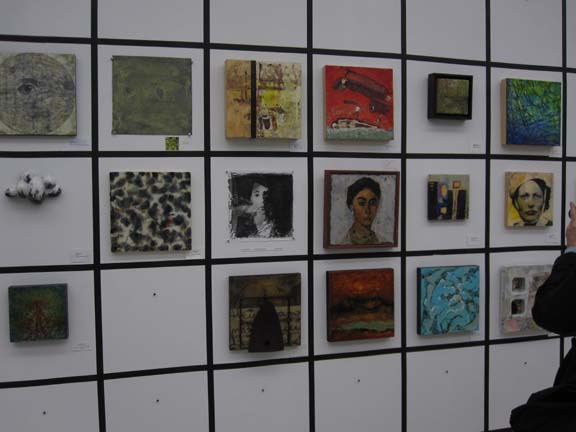
We had a great official first day at the Fourth Annual Encaustic Conference yesterday.Watching the hallway show, Best Foot Forward, develop as conferees arrived and hung their work was just fascinating. I took a series of photos that showed the walls at various stages. Here are a few of them. (Note that you can click on any image to open it larger.)


I loved this 3D piece by Toby Sasson, an important new member of New England Wax. (Yes, all NEW members are important but I meant this in a particular way - see Comments on this post for my explanation.)


Sorry I don't have time to post more photos and to identify individual artists, but more later. Joanne Mattera is  to choose the Director's Award from this show, and I don't envy her. The quality and diversity of the work that has been hung is just fabulous. It's wonderful to see all in one place how wide-ranging the interests and excellence of the work of conferees. Everyone is raving about it.


 The day didn't officially start until the first talk began at 1:00 p.m., but the vendor tables opened at 10:00 and many conferees took the opportunity to get a jump on the crowd and go shopping. Of course I was among them and got some paint from Evans Encaustics, some paintsticks on sale at RandF paint and a signed copy of Daniella Woolf's new book, Encaustic With a Textile Sensibility. I went back in the afternoon to get four of the giant spatulas that Kama Pigments was selling and a bottle of Miles Conrad's new non-toxic wax solvent. Don't you just love shopping for art materials?

We had a superb talk last night about Jasper Johns by Dr. Roberta Bernstein, who is THE authority on his work and is completing the Catalogue Raisonne of the Paintings and Sculptures of Jasper Johns to be published in 2012. She has known Johns personally since the 1960s, wrote her Ph.D. dissertation about him and thoroughly understands the important role that the encaustic medium played in the development of his work. What a treat to her her talk from the perspective of encaustic! More about her talk later because I took photos of the slides she showed and despite the distance and low light situation, many of them came through clearly enough to post.

So there is much more to come. It's hard to tear myself away from real time to dabble in the virtual. I love blogging but reality is such a concept.


Friday, June 11, 2010

Live from the Encaustic Conference

I arrived at the Fourth Annual Encaustic Conference at Montserrat College of Art about 5:00 p.m. on Thursday night. There was a moderate amount of activity - early arrivals were registering and checking into the dorm and vendors were setting up their tables. Here are a LOT of images. (Note that you can click on the images to expand them to a larger size.)


First view of Best Foot Forward in the second floor hallway of the Hardie Building. This shot was taken around 6:00 p.m. Thursday night.


Here's a view looking in the other direction.

I'll be posting more images of Best Foot Forward as people arrive and hang their work.

VENDORS
Vendors open at 10:00 a.m. this morning (Friday). What great products they have! And some special sale items also.


Hylla Evans of Evans Encaustics - her usual wonderful colors plus those great hake brushes in 3 sizes


R and F Paints - great "scratch and dent" sale on pigment sticks!


Conrad Wilde paints and other supplies - luscious colors


Rodney Thompson's fabulous panels


Enkaustikos paints - a large selection of paints, brushes and tools


New vendor Kama Pigments has lots more than pigments...


including these fabulous giant spatulas

I have left out Paul Roland's encaustic hotboxes for monotypes and all the great encaustic books, including the beautiful new book by Daniella Woolf - but more about those in the next post.


WAX LIBRIS II - The Library Show

I scurried in and took a few shots in the library. I wanted to see how my own work looked of course. So here are a few - not intended to be all inclusive but just to whet your appetite for more.


This show was curated by Joanne Mattera and nicely installed in this book shelf and on the surrounding walls. My three deconstructed book works are on the wall at the left.


Top shelf: Julie Shaw Lutts (sorry I cut off the top of her work), middle shelf Miles Conrad and bottom shelf Gwen Plunkett.


Two works by Laura Moriarty, sort of geology in book form.


Top shelf left Deanna Wood and right Cynthia Winika. Bottom shelf Josie Rodriguez.


A work by Sandi Miot (sorry I don't have the title).


Installation of work with found objects and book covers by Mindy Nierenberg.


This is a long, image-filled post but I thought you might like to see some familiar faces from previous conferences. It is really great to connect with people in person.


THE LUMINOUS LANDSCAPE - the opening of the show at the Kensington Stobart Gallery in Salem.


Many of the early arrivals at the conference headed over to Salem for this opening of encaustic works in the gallery at the Hawthorne Hotel in Salem. The place was packed and it was a little difficult to see the work. So instead, I'm just showing you a few crowd pictures (and featured individuals). You'll have to get to Salem to see the work at a less crowded time. Click to get Kensington Stobart Gallery hours, directions and info.


New England Wax member Deb Claffey in the doorway to the gallery.


Greg Wright and Kellie Weeks, also NE Wax members.


Greg with his dynamic painting displayed in the gallery window


A shot from the opening - in center Charyl Weissbach, also a NEW member and an organizer of the LL group


What an appealing assortment of food presented by the gallery! And so refreshing to see fruit and vegetables instead of the dreary taco chips and salsa.


A shot of the opening crowd. See any familiar heads?


Another shot that also shows that some paintings were hanging on the wall.

Whew! What a lot of photos. I'll be back with more later.