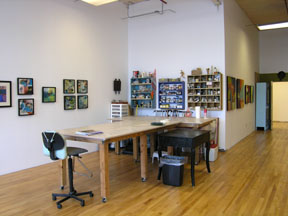
Making art in the studio, listening to music or NPR and thinking, all the time thinking. It could be about red versus orange or politics or the world collapsing around us or growing old or (most probably) wondering what to have for dinner.
I like to visit New York a few times a year to see new work and old favorites. Knowing that El Anatsui has a show up at Jack Shainman Gallery in Chelsea is always a great motivator for my visiting schedule. Last month, he not only had a gallery show (see my Anatsui in New York post #2 still to come), but just down the street was a massive installation of his "Broken Bridge II" on the side of a building between W 21st and W 22nd adjacent to the High Line and in the heart of the Chelsea gallery district.(On exhibition until September 2013)
By the way, if you don't know about the High Line, here's a link that will tell you all about it.
(CLICK PIX TO ENLARGE)
Anatsui's "Broken Bridge" as shown in Paris during the 2012 Triennial
(from http://blogs.artinfo.com/artintheair/2012/06/25/el-anatsui-wraps-entire-building-facade-for-paris-triennial/)
Night view of the Paris installation
Now for the comparison of the New York work:
"Broken Bridge II" by El Anatsui at the High Line in New York
(photo by Austin Kennedy from the High Line blog)
Experimentation, Change and Adaptation
So, you will note that although BBII is made using the same elements as the original BB, it has an entirely different appearance. For one thing, that overhanging structure on the Paris building made a very strong top edge that confined (and I think literally overshadowed) Atatsui's piece. In the High Line work, unconstrained by architecture, he wanted to emphasize the sky, the buildings reflected in the mirror and the architectural shapes he saw. He speaks about that in this Art 21 video: Exclusive | El Anatsui: “Broken Bridge II”
I went to see Anatsui speak at the opening of his show "When I Last Wrote to You About Africa" at Wellesley College in April 2011. During his talk he stressed that he has a love of experimentation, change and adaptation and wants his work to reflect those considerations. Much of his work is modular so that it can be rearranged depending on where it's installed. He is not at all precious about his work and often takes it apart if it comes back to his studio to use in new pieces. He calls the salvaged parts "readymades." (You can read my blog post about his Wellesley show here.)
Remaking the Piece
Take a look at this compressed-time installation video from the High Line blog. The blacked out spot in the middle is Hurricane Sandy.
A Walk Along the High Line
I took a series of pictures as I walked along the High Line with my artist friends Binnie Birstein and Tamar Zinn. I thought that approaching this massive piece was a little surprising because it wasn't immediately apparent that it was there. Although it measures 37 feet high by 157 feet long, it's composed of mirrors and rusted metal that camouflage it in its surroundings--the mirrors blend in with the sky and the rust color blends in with aged brick nearly until you get right up to it. Have a look. (and click to enlarge the pix)
This is the last photo of "Broken Bridge II." The rest of the photos give you the feeling of
looking around at the architecture and plantings as you walk along.
One further note, in one close-up of "Broken Bridge II" you can clearly see the rusty perforated metal in the piece. This metal was traditionally used for grating cassava (also called yuca, mogo, manioc, mandioca, and kamoteng kahoy - see the Wikipedia entry about its importance here)
And I'll leave you with this image of an earlier Anatsui work that used discarded cassava graters, "Crumbling Wall," 2000.
Remember when I went to New York? Well, I barely do. It seems so long ago, but I insist on dredging my cluttered memory bank to bring you the remnants of my experiences. Thank goodness for photos or my mind would be a complete blank (well, nearly).
Three works by Ruth Hiller. The gallery website gives the dimensions of the
far right piece, called "oe", as 34 x 14 x 2 inches.
NOTE: Click on any of these images and they will open larger.
Ruth Hiller at Winston Wachter
So there we were in Chelsea - hot, tired but determined. We wanted to see Ruth Hiller's show at Winston Wachter on West 25th Street. (Note: there is an umlaut over the "a" in Wachter but I don't know how to add it.) Ruth is an encaustic homie and her work looked great in the gallery. I have to admit right up front, however, that I failed to get the titles and sizes for individual pieces.
Greg acting as the human scale again with large pieces by Hiller
Ruth's statement says that she is exploring "the parallels between microscopic and macroscopic elements....I find the visual similarities astounding." These are parallels that Greg has also explored in his work. Ruth works with very smooth surfaces on panels or slabs of wood with rounded corners. Each piece has one or more dimensional protuberances that are sliced open to show layers of color within. She calls this work "3D encaustic."
Side view of one of the works
One small room in the gallery was lit with blacklight to illuminate Hiller's use of fluorescent pigments.
Four large works
Hiller's saturated colors, rounded forms and colorful three-dimensional elements made for an unusually minimalist exhibition of work in encaustic that was striking in its simplicity and clarity of concept.
Binnie with one of Hiller's large pieces
Along with Ruth Hiller (her website here), the gallery was showing poured enamel paintings by Leah Durner and glass sculpture by Eric Woll. The resonance between the works of the three artists made for a unified show with a pared back but vibrantly colorful look.
Four large poured latex enamel works by Leah Durner
Closeup of two Durner works
Installation of glass beetles by Eric Woll entitled "The New Normal",
60 x 47 x 7 inches
Glass squirrels by Eric Woll
This is Winston Wachter's summer show and it will run until some time in September (date not given), so there is still time to see it in person.
Li SongSong at Pace Gallery
We happened to be walking by Pace on West 25th Street and stopped in because the building looked so attractive.
Exterior of Pace Gallery, West 25th Street, Chelsea
When we went inside the massive space, I was overwhelmed by the heavy impasto on the gigantic paintings by Li SongSong. I was so fascinated with trying to capture the dimensional effect of the two or three inch thick painted surfaces, that I barely scanned the overall images presented in the work.
The gallery's website says this is the first solo U.S. exhibit by 38-year-old Chinese artist Li SongSong, and the show consisted of 11 giant works, up to 17 feet wide.
First big gallery in the nterior of Pace
This is a detail of the painting in the photo above that's behind
the two viewers. I didn't see the image of the painted figure until
I later looked at this photo. All I could see in person was texture.
I was hoping to include some better photos of the work from the gallery's website, but apparently they are not allowing the photos to be grabbed. And they don't have info about the size of each work or the subject. So all I can say is that the paintings were constructed from slabs of canvas or aluminum overlapping one another and they were very big.
Here's a side view of one of the biggest paintings that was constructed from
slabs of painted aluminum.
Another view of the same piece
And still another view
You can see that I went right into construction mode when I saw this work.
And here's a closeup of the impasto that looks like cake frosting
The website says that Li works from photographs and film stills, some of which record world history and some of which are more personal. He blows up and grids the images into panels and then grids again with pastel colors and graphic patterns that distort the images, sometimes digging through the impasto to hidden colors layered underneath. This technique makes the original images "become[s] abstract and expressionistic, both obscuring and neutralizing the original content as it explores the imperfection of memory."
Two paintings in the show that certainly look like they commented on Chinese society -
and not in a good way.
Tamar Zinn at The Painting Center
When our plans for New York had firmed up a bit, I arranged to meet my Facebook friend, Tamar Zinn on Friday afternoon. We seem to agree so frequently on political comments as well as art in Facebook, that I thought it would be fun to meet each other in person. Coincidentally, Lynette Haggard had just posted an interview with Tamar in her blog and Tamar had two paintings in the show "Grey Matter" at The Painting Center.
Two works by Tamar Zinn in "Grey Matter"
Tamar's wall in the show - we thought it was the best of the exhibition
Before meeting Tamar, we first went to The Painting Center on 27th Street to see the show. This is a great space, a non-profit, that shows about 20 exhibits a year and posts images of artists' work in a online database, the Art File, and in an artists' registry. For details see the Center's website. (And by the way, they are closed for the summer.) Tamar's work looked great in person. You can see more of it on her website.
Overhead view of the High Line
(all images, unless otherwise noted, from the High Line website)
The High Line
Next we headed over to the High Line, an elevated public park. I have heard so much about it and was really looking forward to seeing it in person. (Don't forget to click pix to enlarge.)
The abandoned High Line
A brief history taken from the website: The elevated railbed was originally built in the 1930s to remove dangerous freight traffic from the city streets as part of the West Side Improvement Project. (There were so many accidents between trains and street traffic before the High Line was built, that 10th Avenue was known as "Death Avenue.") The last trains ran in 1980 and the railbed was abandoned until demolition was threatened and Friends of the High Line, a community-based non-profit group, was formed to save it in 1999. After a lot of hard work by the group and its supporters, the property was handed over to the city, a design process began and the selected team of James Corner Field Operations, landscape architects, and Diller Scofidio + Renfro, an architecture firm ("experts in horticulture, engineering, security, Maintenance, public art and other disciplines") began design and construction. (Check out those websites for some fabulous project info on the High Line and others - worldwide.)
Here's a great computer-generated video that shows the design process in flyover mode - really cool.
The High Line was scheduled to open in three phases: Phase One June 2009, Gansevoort Street to West 20th Street, and Phase Two June 2011,West 20th Street to West 30th Street. (I don't know what happened to Phase Three but apparently CSX Railroad still owns the section between West 30th and West 34th Streets.)
Overhead view of High Line park
People walking on the High Line with traffic below
Plantings - now really huge
People relaxing on wooden loungers
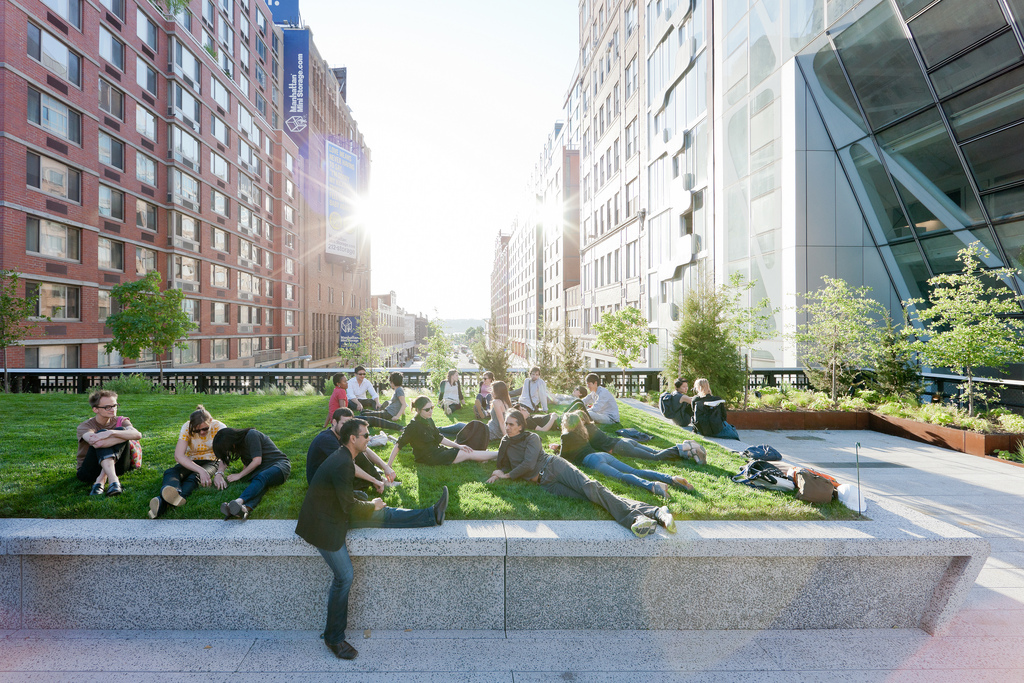
New Yorkers needing a lawn to lounge on
Watertowers visible from the High Line - note how pathway contains rail-like
impressions in the concrete
My skyline view with plantings foreground
Viewing windows to the street below
High Line at dusk looking out toward the piers
This park is really spectacular. The photos here don't show how varied the plantings are and that some are really large scale. They are like prairies or meadows of native plants, most now in flower or with seedheads from flowers that have passed. I was sorry that my Iphone had run out of gas by the time I got to the High Line, but these photos from the website are probably way better than I could ever have done anyway.
So we had a great time sitting at a little table and chairs, enjoying the people watching in a cool breeze and waiting for Tamar to join us. It was a real pleasure to meet her in person and learn about her life in the city. After chatting for a while, we walked along the High Line and then left it to pass through the now-totally gentrified Meatpacking District and up to 7th Avenue. We had dinner at a Japanese restaurant recommended by Tamar, where we were joined by Winston Lee Mascarenhas, another encaustic homie, who was in New York for a residency at the School of Visual Arts.
By the time we trained it back to Binnie's in Connecticut, it had been a very full day. But on Saturday, we were getting up bright and early to make it to the Met for the Alexander McQueen exhibit. More about that in the next post - if I can remember that far back.
So clean, so neat, so unused (click picture for link to my website) - my URL - http://nancynatale.net, Email: nancynatale@gmail.com
My work is now included on Geoform
This is an online scholarly resource and curatorial project of Julie Karabenick that features works by artists around the world. CLICK THE IMAGE TO SEE THE SITE.
Still available from blurb.com: The Running Stitch Series
Click picture to link to blurb.com
A portfolio of my work is included in this beautiful new book
Encaustic Works 2012: A Biennial Exhibition in Print, organized by Laura Moriarty and designed by Heather K. Aderson, with an essay by juror Joanne Mattera; artwork on cover by Ellen Koment.
Now that I have the search feature on the blog, you can use it to find posts about a particular subject. It works like a charm. Thanks, Google!
Some topics you might like to look up:
El Anatsui
Richard Diebenkorn
Leonardo Drew
Encaustic conference
Encaustic painting
Philip Guston Joan Mitchell
Joanne Mattera
Lee Bontecou
New England Wax
Physical Geography
MarkRothko - 6 posts about him and the bio by Breslin
Hedda Sterne Studio photos
Followers
What am I reading?
I'm always reading something and now it's another one of Robert Caro's volumes of Lyndon Johnson's biography. "Passage of Power" is the fourth volume in this monumental series and covers the years 1958 to 1964. This period of Johnson's life was full of extremes of power - from the peak as Majority Leader of the Senate, then fading as he failed to actively campaign for the presidential nomination in 1960. Once he joined Kennedy on the 1960 Democratic ticket, his southern connections gave Kennedy the win, but Johnson sank into powerless oblivion and became the butt of jokes by "the Harvards." On Kennedy's death, Johnson ascended to the presidency and experienced another series of extremes of political power.
Caro is a master of biography and is always interesting and informative. I recommend this volume (and series) to anyone who follows politics and wants to know some background on how we got where we are today.